
Choosing the right type of trailer for transporting heavy or oversized equipment is crucial for safety and efficiency. If you are specifically comparing removable gooseneck loading with rear-ramp loading, see our RGN trailer vs lowboy trailer guide as a deeper follow-up.
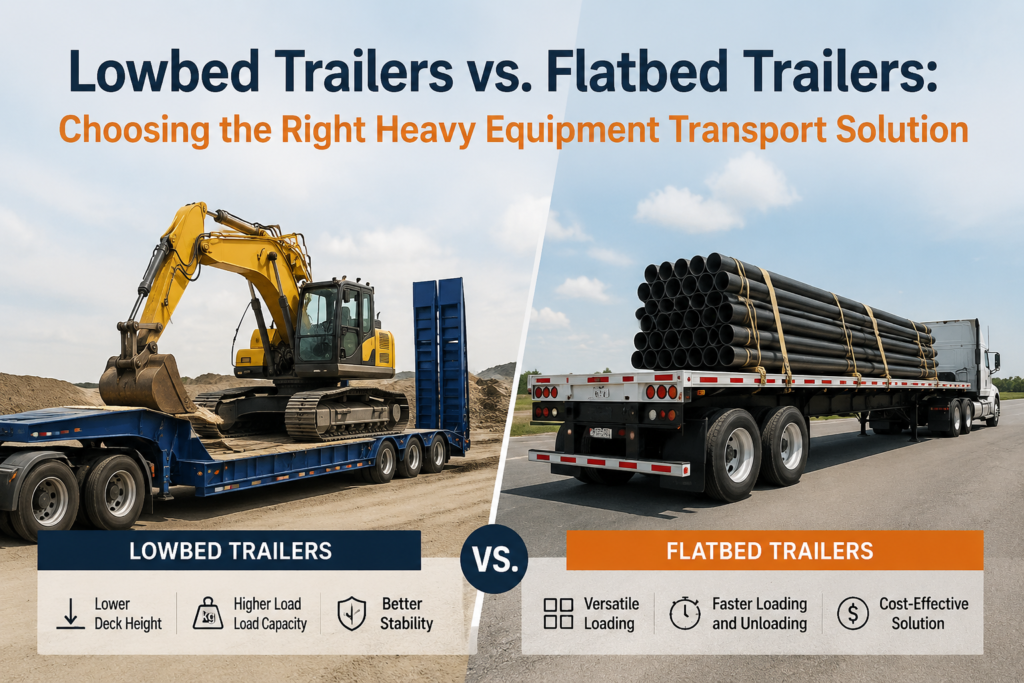
1. Design and Structure: Tailored to Specific Needs
Lowbed Trailers: Built for Heavy and Oversized Loads
Lowbed trailers are designed with a low-profile deck, allowing for easy transport of tall and heavy equipment. The lowered height is particularly beneficial when transporting large machinery that requires special clearance. These trailers often feature a detachable gooseneck, allowing machinery and vehicles to be driven directly onto the trailer, which eliminates the need for cranes.
- Low Ground Clearance: The deck is closer to the ground, making loading and unloading easier for tall equipment such as bulldozers, cranes, and large construction machinery.
- Detachable Gooseneck: This feature enables easy loading and unloading of large equipment by allowing access to the deck from the front.
- Heavy-Duty Axles: Designed to carry extremely heavy loads, lowbed trailers are perfect for transporting equipment that exceeds the weight limits of regular trailers.
Flatbed Trailers: Ideal for Bulk Cargo and General Freight
In contrast, flatbed semi trailer options offer a simple and versatile open-deck design for general freight and bulk cargo that does not require special handling or low clearance.
- Open Flat Deck: Provides a large, unobstructed area for loading and unloading various types of cargo, such as steel beams, lumber, and large containers.
- Standard Ground Clearance: Although the clearance is adequate for many types of cargo, flatbed trailers do not provide the specialized low height of a lowbed trailer.
- Flexible Loading Options: Flatbed trailers allow loading from the side, rear, or using cranes for heavier items.
2. Load Capacity: Handling Heavy Loads
Lowbed Trailers: Heavyweight Transport Solutions
Lowbed trailers are engineered to transport heavy machinery and oversized equipment. These trailers are capable of handling loads that exceed the limits of standard flatbeds. With reinforced frames and heavy-duty axles, lowbed trailers can carry up to 100 tons or more, depending on the model.
- Ideal for Heavy Equipment: They are perfect for carrying construction machinery, mining equipment, and large vehicles like excavators and tractors.
- High Load Capacity: Lowbed trailers are designed to carry extremely heavy loads, making them the best option for large-scale equipment transportation.
Flatbed Trailers: Suitable for General Cargo
Flatbed trailers, while versatile, are not built to handle the extreme weight of large industrial machinery. They are better suited for lighter and more standard freight such as building materials, long steel pipes, and automotive parts.
- Moderate Load Capacity: Flatbed trailers typically carry between 20 to 45 tons of cargo, which is sufficient for most construction materials but not ideal for extremely heavy machinery.
- Best for Bulk Transport: These trailers excel at transporting standard loads, including lumber, steel beams, and other bulky but not overly heavy items.
3. Applications: Where Each Trailer Excels
Lowbed Trailers: Perfect for Specialized Equipment
Lowbed trailers are specifically designed for heavy equipment transport. Whether you’re moving large construction machinery, mining equipment, or oversized vehicles, these trailers provide the ideal solution. The low ground clearance makes it easier to load and unload tall and heavy machinery, reducing the risk of damage during transit.
- Common Applications:
- Transporting heavy machinery like cranes, bulldozers, and mining equipment.
- Carrying large vehicles such as buses, trucks, or oversized tractors.
- Moving industrial equipment such as generators, transformers, and heavy-duty engines.
Flatbed Trailers: Ideal for General Freight
Flatbed trailers are best suited for transporting bulk cargo and general freight that doesn’t require the low ground clearance of a lowbed trailer. Their versatility allows for a wide range of cargo types, including construction materials, pipes, and containers.
- Common Applications:
- Hauling building materials like concrete, steel, and lumber.
- Transporting long loads, such as steel rods and large pipes.
- Carrying automotive parts and smaller machinery that do not require special clearance.
4. Loading and Unloading: Efficiency and Convenience
Lowbed Trailers: Easier Access for Heavy Equipment
One of the main advantages of lowbed trailers is the ease of loading and unloading heavy machinery. The low deck height allows equipment to be driven directly onto the trailer, eliminating the need for heavy lifting equipment. Additionally, the detachable gooseneck feature makes it easier to access the deck without using cranes.
- Simple Loading: Heavy equipment can drive onto the trailer without the need for cranes or other heavy lifting machinery.
- Enhanced Safety: The low ground clearance reduces the risk of damage to the equipment during the loading and unloading process.
Flatbed Trailers: Versatile Loading, but Requires Equipment
While flatbed trailers offer flexible loading options, they require more effort when it comes to heavy equipment. Depending on the size and weight of the cargo, you may need cranes, forklifts, or other heavy equipment to load and unload materials safely.
- Versatile Loading: Cargo can be loaded from the side, rear, or by using cranes or forklifts.
- Manual Handling: For heavier or bulkier items, lifting equipment is often required, especially for oversized machinery.
5. Cost Considerations: Choosing the Right Trailer for Your Budget
Lowbed Trailers: Higher Initial and Maintenance Costs
Due to their specialized design, lowbed trailers typically have a higher initial cost compared to flatbed trailers. The reinforced structure, low clearance, and detachable gooseneck all contribute to the increased cost. Additionally, regular maintenance is required to keep these trailers in good condition due to their complex design.
- Initial Cost: Higher than flatbed trailers due to the heavy-duty construction.
- Maintenance: Requires more frequent servicing, particularly for the specialized features.
Flatbed Trailers: Affordable and Low Maintenance
In comparison, flatbed trailers are more affordable and require less maintenance due to their simpler design. While they may not be ideal for hauling heavy equipment, their versatility and cost-effectiveness make them the go-to choice for general cargo transport.
- Initial Cost: Lower than lowbed trailers, making them more cost-effective for businesses with lighter transport needs.
- Lower Maintenance Costs: With fewer complex parts, flatbed trailers are easier and cheaper to maintain.
Conclusion: Making the Right Choice for Your Transport Needs
Choosing between a lowbed trailer and a flatbed trailer depends largely on the type of cargo you need to transport. For heavy equipment and oversized machinery, lowbed trailers are the clear choice due to their low clearance and heavy-duty construction. For general freight, including building materials and automotive parts, flatbed trailers offer a cost-effective and versatile solution.
By understanding the unique advantages of each trailer type, you can make an informed decision and optimize your transportation operations.
FAQ
1. What is the difference between lowbed and flatbed trailers?
Lowbed trailers have a low-profile deck ideal for transporting oversized machinery and heavy equipment, while flatbed trailers are open, flat platforms suitable for general cargo like building materials and automotive parts.
2. Can a flatbed trailer carry heavy machinery?
Flatbed trailers can carry heavy machinery, but they are not designed for oversized or extremely heavy equipment. For such loads, lowbed trailers are more appropriate due to their low clearance and reinforced structure.
3. What is the maximum weight a lowbed trailer can carry?
Depending on the configuration, lowbed trailers can carry up to 100 tons or more, making them ideal for industrial equipment and construction machinery that exceed standard weight limits.
4. Are flatbed trailers more affordable than lowbed trailers?
Yes, flatbed trailers are generally more affordable due to their simpler design and lower maintenance requirements compared to lowbed trailers.
5. When should I use a lowbed trailer?
You should use a lowbed trailer when transporting heavy machinery, construction equipment, or vehicles that require a low ground clearance for safe loading and unloading.