
When choosing the right trailer, many logistics operators ask a simple question: which trailer is better for my business—flatbed semi trailer or drawbar trailer?
The answer depends on how you transport your goods, the type of cargo you handle, and the routes you run every day. Whether you’re managing long-distance heavy haul transport or short-haul urban delivery, selecting the right trailer can make a noticeable difference in cost and efficiency.
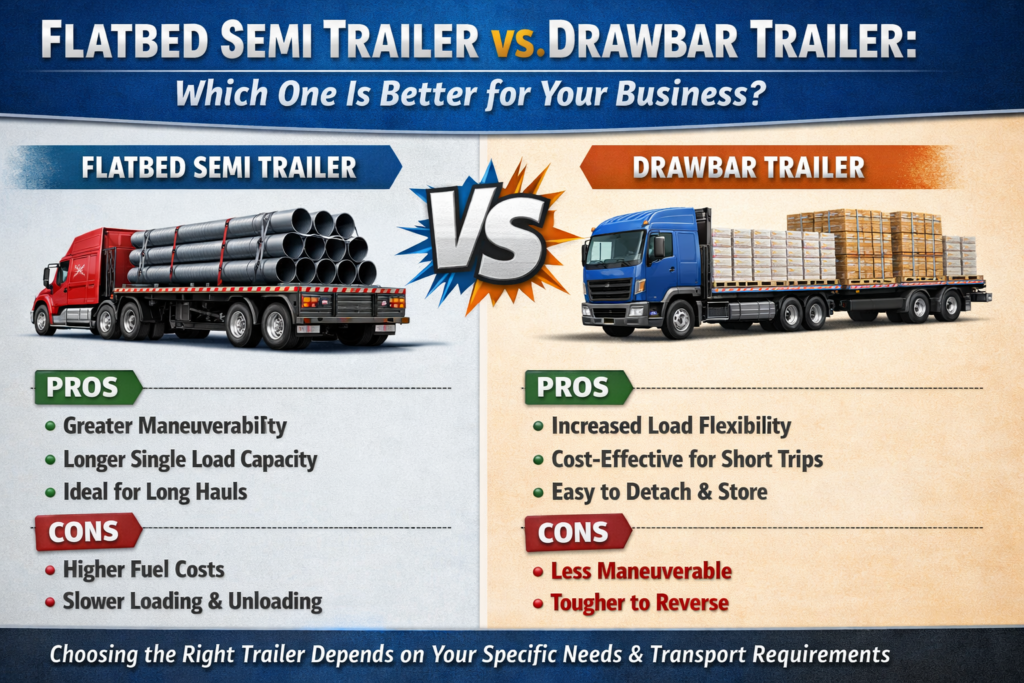
Flatbed Semi Trailers for Long-Distance Heavy Haul Transport
If your business involves moving large or heavy cargo over long distances, a flatbed semi trailer is often the first option people consider—and for good reason.
Why Many Companies Prefer Flatbed Semi Trailers
In real operations, companies often choose flatbeds when they need a reliable solution for heavy equipment transport across long distances.
- Higher payload capacity for construction and industrial freight
Ideal if you’re wondering about the best trailer for construction material transportation - Open deck design for oversized cargo handling
Especially useful when dealing with irregular loads that don’t fit inside enclosed trailers - Better stability for highway transport
A key factor if you’re comparing semi trailer vs drawbar trailer pros and cons for long routes
From experience in the logistics industry, businesses that operate between ports, factories, and project sites tend to rely heavily on flatbed semi trailers for consistency and efficiency.
However, if your daily routes involve tight streets or frequent stops, you might start asking: is a semi trailer practical for city deliveries? In many cases, the answer is no.
Drawbar Trailers for Urban Delivery and Short-Haul Logistics
For companies focused on distribution rather than long-haul transport, drawbar trailers offer a different set of advantages.
Why Drawbar Trailers Work Better for Flexible Delivery
If your operation involves multi-stop delivery routes or regional distribution, a drawbar trailer can be a more practical choice.
- Easier handling in urban environments
A strong option if you’re looking for the best trailer for city logistics and tight delivery routes - More flexible for mixed cargo transport
Suitable for businesses that handle different types of goods in one trip - Better for frequent loading and unloading
Ideal when efficiency matters in short-haul delivery operations with multiple stops
In real-world use, many retail and FMCG companies prefer drawbar trailers because they adapt well to changing delivery schedules.
That said, if you’re considering drawbar trailer vs semi trailer for long-distance transport, drawbar trailers are generally less efficient and less stable at highway speeds.
Flatbed Semi Trailer vs. Drawbar Trailer: What’s the Real Difference?
If you’re still comparing options, here’s a practical breakdown based on everyday logistics use:
| Aspect | Flatbed Semi Trailer (Heavy Haul) | Drawbar Trailer (Urban Delivery) |
|---|---|---|
| Best For | Long-distance heavy cargo transport | Short-haul and city delivery |
| Load Capacity | High | Medium |
| Maneuverability | Limited | Strong |
| Stability | Excellent on highways | Moderate |
| Typical Question It Solves | “best trailer for heavy equipment transport” | “which trailer is easier for city delivery” |
How to Choose the Right Trailer for Your Needs
If you’re still unsure, it helps to think in terms of your daily operations rather than just specifications.
1. Think About Your Routes
Ask yourself:
- Are you mainly doing long-distance freight transport between cities?
- Or handling short-haul delivery with multiple stops?
If it’s the first, a flatbed semi trailer is usually the better investment.
If it’s the second, a drawbar trailer will likely make your work easier.
2. Consider Your Cargo
Another common question is: what is the best trailer for my type of cargo?
- For heavy, oversized loads → flatbed semi trailer
- For mixed or palletized goods → drawbar trailer
3. Compare Cost and Efficiency
Many operators look up: cost comparison between semi trailer and drawbar trailer
In practice:
- Flatbed semi trailers are more efficient for bulk transport over long distances
- Drawbar trailers are better for flexible, lower-volume delivery models
4. Think About Daily Operations
Sometimes the decision comes down to a simple question:
which trailer is easier to use for my drivers?
Drawbar trailers are generally easier to maneuver, especially in tight areas. Semi trailers, while more powerful, require more experience to operate efficiently.
FAQ: Real Questions from Logistics Operators
1. Which trailer is better for my business?
It depends on your operation. If you handle long-distance heavy haul transport, a flatbed semi trailer is usually the better choice. For urban and regional delivery, a drawbar trailer is more practical.
2. What is the difference between a semi trailer and a drawbar trailer?
The main difference is how they are connected and how weight is distributed. This affects stability, maneuverability, and ideal use cases.
3. What is the best trailer for heavy equipment transport?
A flatbed semi trailer for heavy equipment transport is typically the best option due to its load capacity and open design.
4. Which trailer is easier for city delivery?
A drawbar trailer for urban delivery routes is easier to handle, especially in tight spaces and frequent stop scenarios.
5. Can I use both types in one business?
Yes. Many companies combine flatbed semi trailers for long-haul transport with drawbar trailers for regional distribution, depending on their needs.
Conclusion
At the end of the day, the decision often comes down to one practical question:
what works best for your daily operation?
- If your focus is moving heavy loads over long distances efficiently, go with a flatbed semi trailer
- If your priority is flexibility and ease of use in city or regional delivery, a drawbar trailer is the better fit
Choosing the right trailer isn’t just about specs—it’s about how well it supports the way you actually run your business.