
Buying a flatbed semi trailer is a long-term investment. While buyers often compare trailer dimensions, payload capacity, axle brands, and other key specifications covered in our complete flatbed semi trailer buying guide, the suspension system is just as important. It determines how the trailer behaves under load, how well it handles rough roads, and how much maintenance it will require over the years.
A suspension that performs well on European highways may not survive the demanding conditions found in African mining regions. Likewise, a system designed for heavy construction equipment may not be the best choice for transporting fragile industrial products.
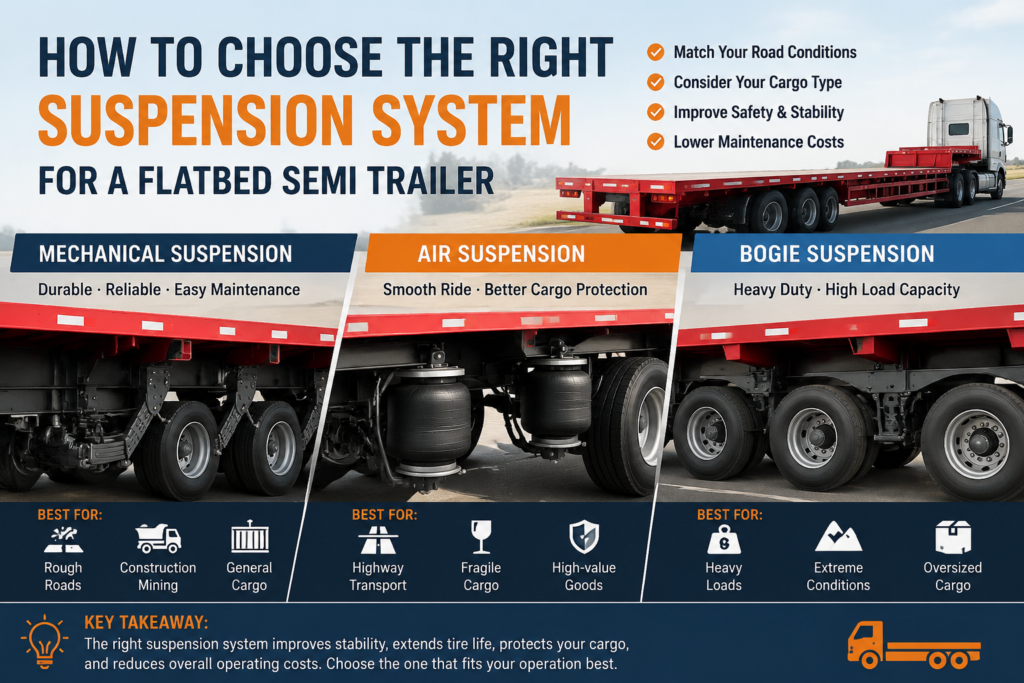
There is no suspension that is “better” in every situation. The right choice depends on where the trailer operates, what it carries, and how it will be maintained throughout its service life.
This article explains the characteristics of the most common trailer suspension systems and provides practical guidance based on real transport applications rather than theoretical specifications.
Why this matters: Selecting the right suspension from the beginning can reduce maintenance costs, improve tire life, protect cargo, and increase the trailer’s overall service life.
Why Suspension Matters More Than Many Buyers Realize
Every kilometer a trailer travels transfers force from the road to the chassis. The suspension system absorbs and distributes these forces before they reach the frame, axles, wheels, and cargo.
When the suspension is properly matched to the operating conditions, the trailer remains stable, components wear more evenly, and maintenance intervals become more predictable.
If the suspension is unsuitable for the application, the consequences usually appear gradually rather than immediately. Tires begin wearing unevenly, bolts loosen more frequently, the frame experiences greater stress, and drivers notice reduced stability under heavy loads.
For fleet operators, these issues often cost far more than the initial savings from purchasing a lower-priced suspension.
Understanding the Three Most Common Suspension Systems
Most flatbed semi trailers are equipped with one of three suspension types:
- Mechanical suspension
- Air suspension
- Bogie suspension
Each was developed to solve a different transport challenge, and each has situations where it performs exceptionally well.
Rather than asking which suspension is the “best,” buyers should ask which suspension is the most appropriate for their daily operation.
Mechanical Suspension: Built for Reliability
Mechanical suspension has remained the preferred choice for heavy-duty transport for decades because of its straightforward design and proven durability.
Instead of relying on air pressure, it uses steel leaf springs and equalizer beams to distribute weight between the axles. The design is simple, but simplicity is exactly what makes it dependable in demanding environments.
It is commonly selected for:
- Construction projects
- Mining operations
- Steel transportation
- Container logistics
- Long-distance freight on rough roads
One reason mechanical suspension remains popular in Africa and the Middle East is that it can often be repaired using locally available parts and standard workshop equipment. When a trailer operates hundreds of kilometers from the nearest service center, ease of repair becomes far more valuable than ride comfort.
When Mechanical Suspension Makes Sense
Mechanical suspension is usually the better option if your trailer:
- Regularly carries heavy cargo
- Travels on gravel or uneven roads
- Operates in remote regions
- Prioritizes durability over ride comfort
- Requires low maintenance costs
Air Suspension: Designed for Smooth Transport
Air suspension was developed to improve ride quality by replacing traditional leaf springs with air bags that automatically adjust according to load conditions.
Because road shocks are absorbed more effectively, vibration reaching the cargo is significantly reduced. This makes air suspension particularly suitable for transporting products that are sensitive to movement.
Industries that commonly use air suspension include:
- Electronics
- Pharmaceutical logistics
- Glass manufacturing
- Precision machinery
- High-value industrial equipment
For companies operating mainly on paved highways, air suspension can also improve driver comfort and reduce long-term tire wear.
However, these advantages come with greater system complexity. Air compressors, valves, air bags, and pneumatic lines all require regular inspection and maintenance.
Bogie Suspension: Built for Extreme Loads
Some transport operations place far greater demands on a trailer than standard logistics.
Mining equipment, quarry machinery, transformers, and oversized industrial components can generate axle loads well beyond those encountered in normal freight transport.
In these situations, bogie suspension is often the preferred solution.
Its heavy-duty design prioritizes strength and load distribution rather than ride comfort, making it suitable for environments where structural durability is the primary concern.
Although bogie suspension increases trailer weight, the additional strength is often essential for specialized heavy transport.
Road Conditions Should Influence Your Decision
One of the most common purchasing mistakes is choosing a suspension system without considering where the trailer will actually operate.
For example, a logistics company delivering packaged consumer goods between major cities may benefit from air suspension because the roads are generally smooth and cargo protection is important.
A contractor transporting excavators between construction sites faces completely different conditions. Rough terrain, temporary roads, and heavy equipment place continuous stress on the suspension, making mechanical suspension a far more practical solution.
In mining operations, durability usually outweighs ride comfort altogether.
The same trailer can perform very differently depending on the environment in which it operates.
Looking Beyond Purchase Price
Price is always an important consideration, but it should never be the only one.
A lower-priced suspension may appear attractive during procurement, yet become more expensive after several years of operation because of increased maintenance, more frequent repairs, and shorter component life.
Experienced fleet managers typically evaluate suspension systems based on total ownership cost rather than purchase price alone.
Factors such as spare parts availability, maintenance capability, tire life, downtime, and operating environment all contribute to the true cost of ownership.
Final Recommendation
There is no universal suspension system that suits every flatbed semi trailer.
Mechanical suspension remains the preferred option for demanding environments where durability, ease of maintenance, and reliability are the highest priorities.
Air suspension is better suited to highway transport and high-value cargo that benefits from improved ride quality and reduced vibration.
Bogie suspension is the logical choice for specialized heavy-haul operations where maximum load capacity is essential.
The best decision comes from understanding your own transport operation rather than selecting the suspension with the lowest price or the longest feature list.