
A flatbed semi trailer is one of the most versatile pieces of transportation equipment used in modern logistics. From shipping containers and steel coils to heavy machinery and oversized construction materials, flatbed trailers play an essential role in keeping industries moving around the world.
Although the design appears simple, selecting the right flatbed trailer requires much more than comparing prices. Payload capacity, axle configuration, steel quality, suspension type, road conditions, and local transport regulations all influence long-term operating costs and transport efficiency.
Many buyers discover this only after putting a low-cost trailer into service. Excessive maintenance, cracked main beams, rapid tire wear, and overloaded axles often result from choosing a trailer that was never designed for the actual working environment.
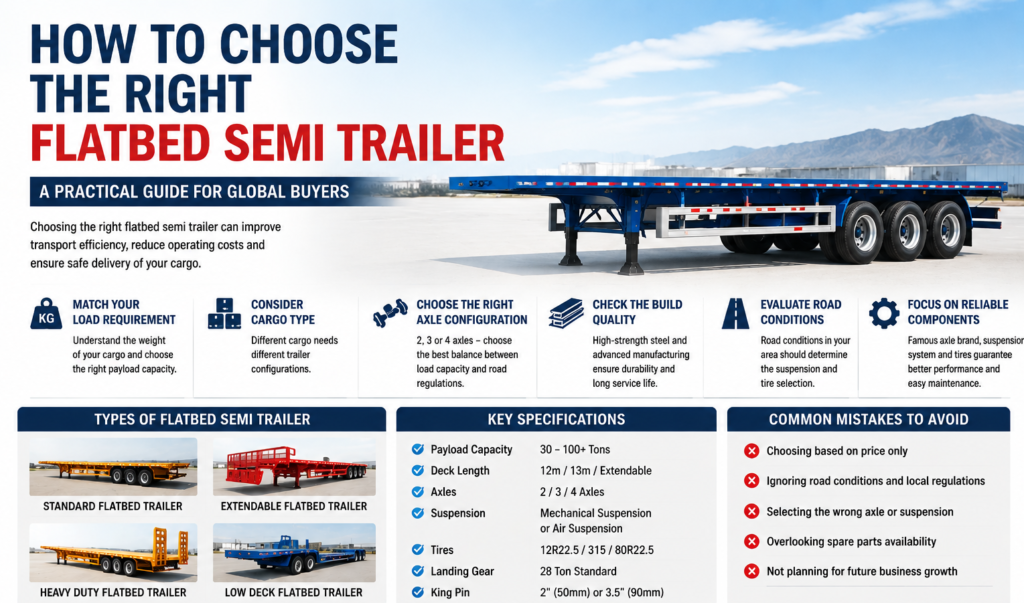
Based on years of manufacturing and exporting trailers to customers across Africa, the Middle East, Southeast Asia, and South America, this guide explains how to choose a flatbed semi trailer that delivers reliable performance throughout its service life.
What Is a Flatbed Semi Trailer?
A flatbed semi trailer is an open-deck transport trailer designed to carry heavy, oversized, and irregularly shaped cargo. Unlike enclosed trailers, it has no roof or side walls, allowing cargo to be loaded from the top, sides, or rear using forklifts, cranes, or other lifting equipment.
This simple yet practical design makes flatbed trailers one of the most flexible transport solutions available today. Whether transporting standard freight or specialized industrial equipment, they can accommodate cargo that would be difficult or impossible to load into enclosed trailers.
Typical cargo includes:
- Steel plates and coils
- Construction materials
- Concrete products
- Shipping containers
- Agricultural machinery
- Mining equipment
- Wind turbine components
- Industrial machinery
- Pipes and structural beams
- Oversized cargo
Because of their adaptability, flatbed trailers are widely used in ports, logistics companies, construction projects, manufacturing plants, mining operations, and infrastructure developments around the world.
Why Flatbed Semi Trailers Remain the Industry Standard
The popularity of flatbed trailers is not simply due to their lower purchase cost. Their real value lies in operational flexibility.
Faster Loading and Unloading
Since there are no side walls or roof, cargo can be loaded from virtually any direction. This reduces loading time and allows cranes or forklifts to operate more efficiently.
Greater Cargo Flexibility
A single trailer can transport containers one day, steel beams the next, and construction equipment the following week. This versatility helps fleet owners maximize equipment utilization.
Lower Maintenance Requirements
Compared with enclosed trailers, flatbeds have fewer structural components that require repair or replacement. With proper maintenance, a high-quality trailer can provide reliable service for many years.
Suitable for International Logistics
Flatbed trailers are widely accepted across global transport markets and comply with a variety of cargo handling methods, making them an ideal choice for international freight operations.
Main Types of Flatbed Semi Trailers
Different transport tasks require different trailer configurations.
Standard Flatbed Semi Trailer
The standard flatbed is the most common model used for general freight and container transportation.
It provides an excellent balance between cost, payload capacity, and operational flexibility.
Typical applications include:
- Container transport
- Building materials
- Industrial equipment
- Palletized cargo
- General logistics
For most logistics companies, this configuration offers the best overall value.
Extendable Flatbed Trailer
Some cargo simply exceeds the length of a conventional trailer.
Extendable flatbed trailers solve this problem by allowing the deck length to increase when required.
Common applications include:
- Wind turbine blades
- Long steel structures
- Bridges
- Pipelines
- Precast concrete components
Although more expensive than standard models, extendable trailers eliminate the need for specialized oversized transport equipment in many situations.
Heavy-Duty Flatbed Trailer
Heavy-duty flatbeds are designed for demanding operating environments where durability takes priority over purchase price.
Compared with standard models, they feature:
- Reinforced main beams
- Thicker steel plates
- Higher-capacity axles
- Stronger suspension systems
- Enhanced cross-member structures
These trailers are commonly used in mining, quarry operations, oil fields, and large infrastructure projects.
Low Deck Flatbed Trailer
A lower deck height provides improved stability while allowing taller cargo to remain within legal transport height limits.
This design is especially suitable for transporting construction machinery, agricultural equipment, and industrial machinery with a high center of gravity.
Applications Across Different Industries
Flatbed trailers support a wide range of industries because of their ability to carry diverse cargo safely and efficiently.
Construction Industry
Construction companies rely on flatbeds to transport steel, concrete panels, scaffolding, pipes, and heavy equipment between project sites.
Mining Operations
Mining sites often operate on rough roads under heavy load conditions. Reinforced flatbed trailers provide the durability needed for transporting large machinery and raw materials.
Port and Container Logistics
Flatbeds are commonly used to move ISO containers between ports, distribution centers, and inland logistics hubs.
Manufacturing
Factories frequently transport industrial machinery, production equipment, and fabricated steel components using flatbed trailers.
Agriculture
Farm equipment, irrigation systems, tractors, and harvesting machinery can all be transported efficiently using flatbeds.
How to Choose the Right Flatbed Semi Trailer
Selecting the right trailer involves understanding how it will be used rather than simply choosing the lowest price.
Start With Payload Requirements
The maximum operating weight—not the average load—should determine trailer capacity.
A trailer that consistently operates near its design limit experiences greater structural stress, increasing maintenance costs and reducing service life.
Many experienced fleet operators prefer selecting a trailer with additional capacity to provide a safety margin for unexpected loading conditions.
Match the Trailer to Your Cargo
Different cargo types require different structural designs.
For example:
- Containers are best suited to standard flatbeds with twist locks.
- Heavy construction machinery requires reinforced main beams.
- Long steel products benefit from extendable trailers.
- Tall equipment often requires a lower deck height.
Choosing the appropriate design improves both safety and operational efficiency.
Consider Local Road Conditions
Road quality directly affects trailer performance.
Smooth highways place relatively little stress on the chassis, while rough rural roads create continuous impact loading that accelerates fatigue.
In regions with poor infrastructure, buyers should prioritize:
- Stronger chassis design
- Reinforced suspension
- Heavy-duty landing gear
- Durable braking systems
- Premium tires
These features often reduce total ownership costs despite a higher initial purchase price.
Key Technical Specifications
Understanding technical specifications helps buyers compare trailers more effectively.
Payload Capacity
Typical payload capacities range from 30 to 80 tons depending on axle configuration and structural design.
Deck Length
Common deck lengths include:
- 12 meters
- 12.5 meters
- 13 meters
- Extendable configurations
The ideal length depends on cargo dimensions and local transport regulations.
Trailer Width
Standard export width is generally 2,500 mm, although regional regulations may differ.
Steel Quality Matters
The frame is the backbone of any flatbed trailer.
High-strength steel provides greater resistance to bending, fatigue, and deformation while reducing overall trailer weight.
A properly engineered chassis distributes load evenly throughout the structure, minimizing stress concentrations that can eventually lead to cracking.
For operators transporting heavy cargo over long distances, investing in higher-quality steel usually produces a lower lifetime operating cost.
Suspension Systems
Choosing the correct suspension depends on road conditions, cargo sensitivity, payload requirements, and local maintenance capability. Mechanical suspension is generally preferred for rough roads and heavy-duty work, while air suspension provides better ride quality and cargo protection on paved highways.
For a more detailed comparison, read our guide on how to choose the right suspension system for a flatbed semi trailer.
Mechanical Suspension
Advantages:
- Durable
- Lower maintenance
- Cost-effective
- Ideal for rough roads
Recommended for mining operations, construction projects, and many African transport routes.
Air Suspension
Advantages:
- Improved ride quality
- Better cargo protection
- Reduced vibration
- Enhanced driving comfort
Recommended for fragile or high-value cargo transported primarily on paved highways.
Choosing the Right Axle Configuration
Axles determine how weight is distributed across the trailer, how the braking system performs, and whether the vehicle complies with local axle-load regulations. Two-, three-, and four-axle configurations are suited to different payloads and operating conditions.
For a deeper explanation of axle quantity, load limits, road conditions, maintenance costs, and axle brand selection, read our guide: How to Choose Trailer Axles: What Really Matters Before You Buy
Two Axles
Suitable for lighter transport applications with lower purchase costs.
Three Axles
The most common export configuration, providing an excellent balance between payload, stability, and operating costs.
Four Axles
Designed for extremely heavy loads where maximum carrying capacity is required.
Selecting the wrong axle configuration can lead to either overloading or unnecessary operating expenses.
Manufacturing Quality Makes the Difference
Two trailers may appear similar from the outside yet perform very differently after years of operation.
High-quality manufacturing includes:
- Precision CNC cutting
- Automatic beam welding
- Full shot blasting
- Anti-corrosion primer
- Durable polyurethane painting
- Comprehensive final inspection
Consistent manufacturing processes improve structural strength, corrosion resistance, and long-term reliability.
Common Buying Mistakes
Many purchasing decisions focus on the initial quotation while overlooking long-term ownership costs.
Common mistakes include:
- Buying solely based on price
- Ignoring local road conditions
- Underestimating future payload requirements
- Choosing low-quality steel
- Selecting unsuitable suspension systems
- Overlooking spare parts availability
- Failing to consider local transport regulations
A slightly higher investment in a properly specified trailer often results in significantly lower maintenance costs throughout its service life.
Maintenance Tips
Routine maintenance extends trailer life and improves operational safety.
Operators should regularly:
- Inspect tires for uneven wear.
- Check wheel bearings.
- Tighten suspension components.
- Inspect brake systems.
- Lubricate moving parts.
- Examine the chassis for cracks or corrosion.
- Verify lighting and electrical connections.
Preventive maintenance is considerably less expensive than major structural repairs.
Customization Options
Every transport business operates under different conditions.
Common customization options include:
- Trailer length
- Axle quantity
- Suspension type
- Tire brands
- Landing gear
- Brake systems
- Twist locks
- Toolboxes
- Side protection
- Paint color and company branding
A customized trailer can improve productivity while meeting local operating regulations.
Frequently Asked Questions
How much weight can a flatbed semi trailer carry?
Most models carry between 30 and 80 tons depending on their structural design and axle configuration.
Which axle configuration is most popular?
Three-axle trailers are the preferred choice for most international transport operations because they provide an excellent balance between payload capacity and operating costs.
Which suspension is better?
Mechanical suspension is generally better for rough roads, while air suspension offers superior protection for delicate or high-value cargo.
How long does a flatbed trailer last?
With proper maintenance and suitable operating conditions, a high-quality flatbed trailer can remain in service for well over ten years.
Can a trailer be customized?
Yes. Manufacturers can tailor dimensions, axle configuration, suspension systems, braking systems, and accessories to meet specific transport requirements.
Final Thoughts
Choosing the right flatbed semi trailer is about much more than purchasing equipment—it is about investing in long-term operational performance.
The best trailer is not necessarily the least expensive. It is the one that matches your cargo, operating environment, road conditions, and business objectives.
Before making a purchasing decision, evaluate payload requirements, structural strength, suspension type, axle configuration, manufacturing quality, and after-sales support as carefully as you compare prices.
A properly specified trailer delivers greater transport efficiency, lower maintenance costs, improved safety, and a longer service life. Over time, these advantages create a far better return on investment than simply choosing the lowest initial price.
For fleet owners and transport companies planning long-term growth, selecting a reliable manufacturer and investing in the right specifications will always prove more valuable than focusing on purchase cost alone.