
When purchasing a flatbed semi trailer, most buyers compare trailer dimensions, payload capacity, or price long before they ask about the axle specification.
That is understandable. The axle isn’t the first thing people notice.
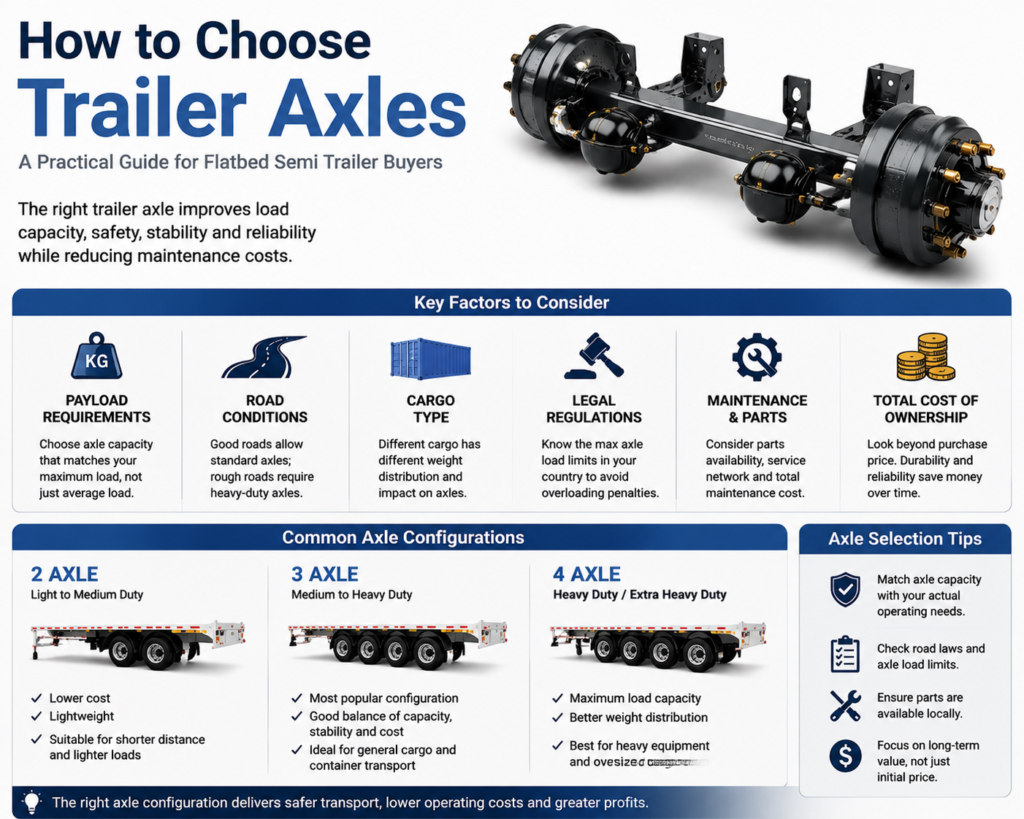
However, after years of operation, it often becomes one of the components that has the greatest influence on maintenance costs, braking performance, tire life, and overall trailer reliability.
A trailer axle doesn’t simply support the wheels. It works together with the suspension, chassis, braking system, and tires to carry every load safely across thousands of kilometres.
Selecting the wrong axle may not create problems immediately. Instead, issues develop gradually through uneven tire wear, overloaded bearings, cracked suspension components, or increased stress on the trailer frame.
For buyers planning to keep a trailer in service for many years, understanding axle selection is just as important as choosing the correct trailer dimensions.
Looking at the complete trailer specification? Our Ultimate Guide to Flatbed Semi Trailers explains how axle configuration, suspension, frame design, and payload capacity work together when selecting a trailer.
Why Trailer Axles Matter More Than Many Buyers Think
Every load carried by a flatbed trailer eventually passes through the axle.
The axle supports the trailer weight, distributes the load between the wheels, transfers braking force to the road, and absorbs continuous impacts from uneven surfaces.
When the axle is correctly matched to the operating conditions, the trailer remains stable, tires wear evenly, and maintenance intervals become more predictable.
When it isn’t, problems usually appear where buyers least expect them—wheel bearings wear prematurely, brake components require frequent replacement, and tire operating costs increase year after year.
For fleet operators, these long-term costs often exceed the difference between buying a lower-priced axle and choosing the correct specification from the beginning.
There Is No Universal “Best” Trailer Axle
One question every trailer manufacturer receives is:
“Which trailer axle is the best?”
The honest answer is simple.
There isn’t one.
The best axle for a logistics company transporting containers on European motorways may be completely unsuitable for a mining contractor working on rough roads in Africa.
Likewise, an axle designed for oversized machinery may not be necessary for companies transporting packaged consumer goods.
Choosing the right axle always begins with understanding the transport application—not the brand name.
Choosing the Right Number of Axles
One of the first decisions buyers face is determining how many axles a trailer actually needs.
Two Axles
Two-axle trailers are generally suitable for lighter transport tasks where payload requirements remain relatively low.
They are commonly used for:
- Agricultural products
- Building materials
- Local deliveries
- Light industrial cargo
Their lower purchase cost and simpler maintenance make them attractive for regional transport operations.
Three Axles
Three-axle trailers have become the international standard for most flatbed semi trailers.
They provide an excellent balance between payload capacity, stability, and operating costs.
They are widely used for transporting:
- 20ft and 40ft containers
- Steel products
- Construction materials
- Industrial equipment
- General heavy cargo
For most buyers, three axles offer the best combination of performance and long-term value.
Four Axles
Four-axle trailers are designed for applications where exceptional payload capacity is required.
Typical industries include:
- Mining
- Heavy construction
- Infrastructure projects
- Large industrial equipment
- Oversized cargo
While additional axles improve load distribution, they also increase purchase cost, maintenance requirements, and trailer weight.
More axles do not automatically make a trailer a better investment.
Road Conditions Should Influence Every Axle Decision
Road conditions often determine axle performance more than payload itself.
A trailer operating primarily on paved highways experiences relatively low vibration and predictable loads.
By comparison, trailers working in quarries, mining operations, or construction sites encounter continuous impact loads that place much greater stress on the axle and suspension system.
This is one reason why many transport companies operating in Africa continue to choose robust mechanical axle systems with widely available replacement parts.
For fleets operating mainly on modern highways, premium axle systems with longer service intervals may offer greater long-term value.
Choosing an Axle Brand
Two axle brands dominate international trailer markets—FUWA and BPW.
FUWA is well known for its competitive pricing, durability, and extensive spare parts availability across Africa, Asia, and the Middle East.
BPW is recognised for precision engineering, long service life, and excellent highway performance.
Neither brand is universally better.
The right choice depends on:
- Road conditions
- Fleet size
- Maintenance capability
- Budget
- Local parts availability
Choosing a brand based only on reputation rarely produces the best long-term result.
Looking Beyond the Purchase Price
Experienced fleet managers rarely ask,
“Which axle is cheapest?”
Instead, they ask,
“Which axle will cost less to own over the next ten years?”
Purchase price represents only a small portion of the total ownership cost.
Maintenance, spare parts, downtime, tire wear, bearing replacement, and fuel consumption all influence the real operating cost of a trailer.
A slightly higher investment today often produces significantly lower operating expenses throughout the trailer’s service life.
Frequently Asked Questions
How many axles does a flatbed semi trailer need?
For most international freight applications, a three-axle configuration offers the best balance between payload capacity, stability, operating cost, and legal road compliance.
Does adding more axles increase payload capacity?
Not always.
Payload capacity depends on the complete trailer design, including the chassis, suspension, braking system, and local transport regulations. Adding more axles alone does not automatically increase legal carrying capacity.
Which axle brand is better, FUWA or BPW?
Both brands have strong reputations worldwide.
FUWA is often preferred where durability, affordability, and spare parts availability are priorities. BPW is commonly selected for fleets operating on well-developed highway networks where long service intervals and premium engineering are important.
How long does a trailer axle last?
There is no fixed lifespan.
With proper maintenance, quality trailer axles can remain in service for many years. Actual service life depends on operating conditions, maintenance practices, road quality, and loading habits.
Can overloaded axles damage the trailer?
Yes.
Continuous overloading places additional stress on bearings, brakes, suspension components, tires, and even the trailer frame itself. Over time, this significantly increases maintenance costs and reduces service life.
How often should trailer axles be inspected?
A basic visual inspection should be carried out before every trip.
Wheel bearings, brake systems, seals, and suspension components should be inspected according to the manufacturer’s maintenance schedule or more frequently under severe operating conditions.
What should I consider besides axle selection?
Axles are only one part of the trailer specification.
Before purchasing a flatbed semi trailer, buyers should also evaluate:
- Payload capacity
- Suspension system
- Main beam strength
- Steel quality
- Tire specification
- Braking system
- Local transport regulations
These factors work together to determine the trailer’s overall performance and operating cost.
Final Thoughts
The right trailer axle isn’t determined by the number of axles or the logo on the hub.
It is determined by how well the specification matches the work the trailer will perform every day.
Understanding your cargo, operating environment, maintenance capability, and local transport regulations will always lead to a better purchasing decision than simply comparing prices.
If you’re still evaluating different trailer specifications, our Ultimate Guide to Flatbed Semi Trailers provides a complete overview of chassis design, suspension systems, payload capacity, manufacturing quality, and other factors that influence long-term trailer performance.