
In the world of trucking and freight transportation, not all trucks operate the same way—even when they look similar at first glance. One of the most common distinctions drivers and industry professionals run into is the difference between a bobtail truck and a semi truck.
At a basic level, the idea is simple: one has a trailer, and the other doesn’t. But once you get behind the wheel—or even just watch how they move on the road—that difference starts to matter a lot more than people expect. Handling, braking, and overall stability all change depending on whether a trailer is attached.
Understanding how a bobtail truck vs semi truck behaves in real conditions isn’t just technical knowledge—it’s something that directly affects safety and day-to-day operations.
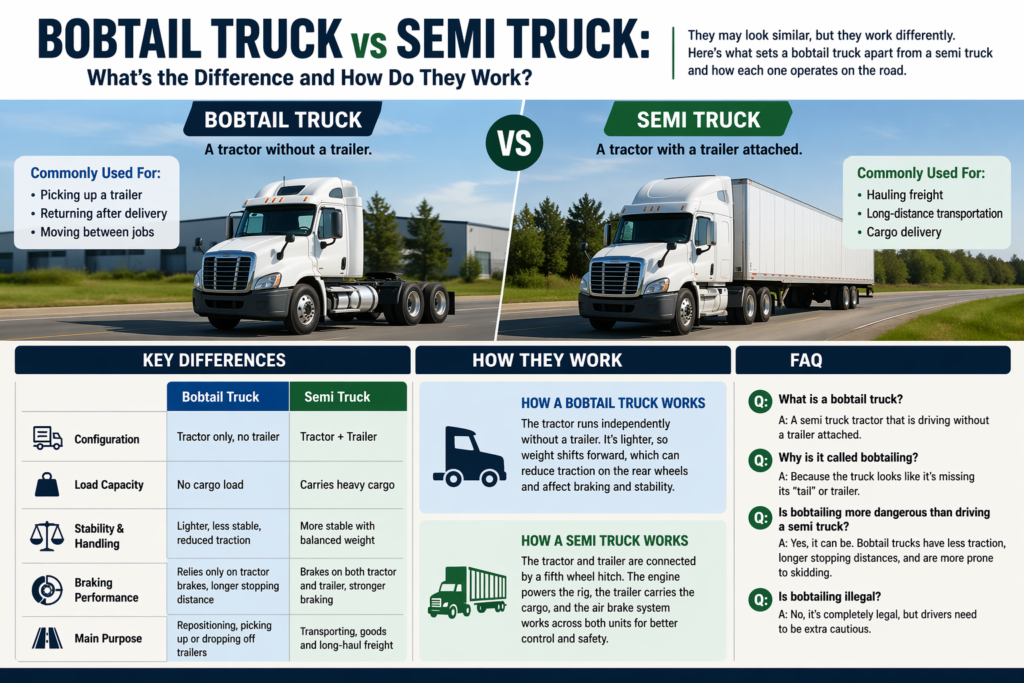
What Is a Semi Truck?
A semi truck is what most people picture when they think of highway freight. It’s the full setup: a tractor truck in the front and a semi trailers attached behind it. For buyers comparing different setups, understanding standard trailer truck length can also help with route planning and compliance.
The tractor contains the engine and controls, while the trailer is where the cargo goes. The two are connected by a fifth wheel hitch, which allows the truck to turn while still supporting heavy loads.
In actual use, everything works together:
- The tractor pulls and powers the vehicle
- The trailer carries the weight
- The braking system is shared across both units
One detail that often surprises people is how stable a semi truck feels when it’s loaded. The added weight from the trailer presses down on the rear wheels, giving the truck better grip and making it easier to manage at highway speeds.
What Is a Bobtail Truck?
A semi truck is what most people picture when they think of highway freight. It’s the full setup: a tractor in the front and a trailer attached behind it. For buyers comparing different setups, understanding standard trailer truck length can also help with route planning and compliance.
You’ll usually see this when a driver is:
- Heading out to pick up a load
- Coming back after a delivery
- Moving between jobs
The term “bobtail” comes from the idea of something being shortened. Without the trailer, the truck looks cut off at the back, and the name stuck over time.
How Driving Changes Without a Trailer
This is where things get more interesting. Even though a bobtail truck is smaller and lighter, it doesn’t necessarily make it easier to drive.
Less Weight on the Rear Axle
When a trailer is attached, a good portion of its weight sits over the rear wheels of the tractor. That added pressure helps with traction.
Without it:
- The rear wheels carry less weight
- Grip on the road is reduced
This can be noticeable when accelerating or driving on wet surfaces.
Braking Feels Different
A full semi truck benefits from having brakes on both the tractor and the trailer. When you remove the trailer:
- Only the tractor’s brakes are working
- The truck may take longer to come to a stop
It’s not always dramatic, but it’s enough to require extra attention in traffic.
Stability Isn’t the Same
Because the weight is no longer evenly distributed:
- The truck can feel less balanced
- Sudden movements are harder to control
That’s why experienced drivers tend to be more cautious when bobtailing, even though the truck is technically lighter.
Bobtail Truck vs Semi Truck: What Really Sets Them Apart
When people compare a bobtail truck vs a semi truck, they’re really comparing two different operating conditions of the same vehicle.
Configuration
- Semi truck: tractor with a trailer attached
- Bobtail truck: tractor only
Road Behavior
- Semi trucks are more stable when carrying a load
- Bobtail trucks can feel lighter but less planted
Function
- Semi trucks are used for transporting goods
- Bobtail trucks are usually in transit between loads
Safety Considerations
- Semi trucks benefit from better traction and braking support
- Bobtail trucks require more careful handling, especially in poor road conditions
When Each One Is Used
In everyday trucking, both setups are part of the job.
A semi truck is used when:
- Hauling cargo
- Running delivery routes
- Operating in long-distance transport
A bobtail truck comes into play when:
- Picking up the next trailer
- Dropping off a completed load
- Moving between assignments
Most companies try to keep bobtail driving to a minimum, since those miles don’t generate revenue.
Efficiency and Operating Costs
From a business perspective, bobtailing isn’t ideal.
Even without a trailer:
- The truck still consumes fuel
- Wear and tear still occurs
- No cargo is being moved
A loaded semi truck, on the other hand, makes better use of every mile. That’s why route planning often focuses on reducing empty runs whenever possible.
Conclusion
The difference between a bobtail truck and a semi truck might look simple at first, but it has a real impact on how the vehicle performs.
A semi truck operates as a complete system, with weight and braking working together to create a more stable ride. A bobtail truck, while common in daily operations, behaves differently and requires a bit more care behind the wheel.
For drivers, understanding that difference isn’t just useful—it’s part of staying safe and working efficiently on the road.
FAQ
What is a bobtail truck?
A bobtail truck is a semi truck tractor operating without a trailer attached.
Is a bobtail truck harder to drive than a semi truck?
In many cases, yes. The lack of weight over the rear wheels can make it less stable.
Why does a bobtail truck have less traction?
Because there’s no trailer adding weight to the rear axle, which reduces grip on the road.
Do bobtail trucks take longer to stop?
They can, since they don’t have the additional braking support from a trailer.
Is bobtailing common in trucking?
Yes, it’s a normal part of operations when drivers are moving between loads.