
Buying a car carrier truck is a practical decision, but it is not always a simple one. Many buyers start by asking how many cars the truck can carry, but capacity is only one part of the story. A suitable car carrier truck buying guide should also match your routes, vehicle types, loading frequency, budget, local road regulations, and long-term maintenance needs.
For a car dealer, a vehicle logistics company, a used car exporter, or a fleet operator, the right car carrier truck can make daily operations much smoother. It can reduce loading time, lower transport cost per vehicle, protect vehicles from damage, and improve delivery efficiency.
This guide explains the main types of car carrier trucks, typical loading capacity, important specifications, price factors, and practical buying tips. If you are still comparing configurations, you can also read our guide on how to choose the right car carrier truck before requesting a quotation.
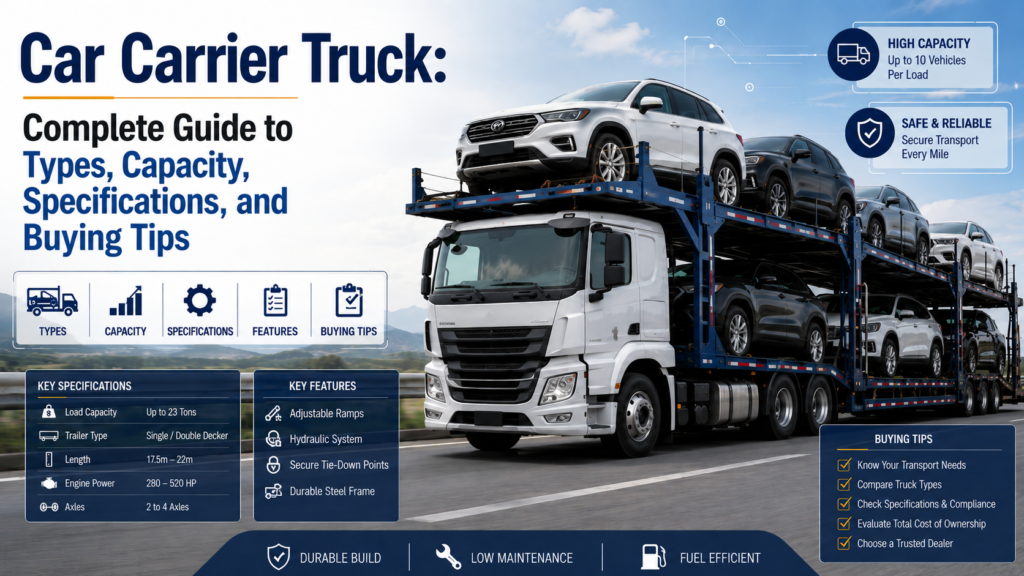
What Is a Car Carrier Truck?
A car carrier truck is a specialized vehicle designed to transport cars and other light vehicles. It is also commonly called a car transport truck, vehicle carrier truck, car transporter truck, auto hauler truck, or car carrier.
Unlike a normal flatbed truck, a car carrier truck is built with vehicle loading platforms, ramps, tie-down points, wheel stops, hydraulic lifting systems, and sometimes upper decks. These structures help vehicles stay stable during loading, transport, and unloading.
Car carrier trucks are widely used for transporting:
- New cars from factories, ports, or storage yards
- Used cars from auctions or dealers
- Vehicles for rental companies
- Fleet vehicles for companies
- Cars between cities or regions
- Damaged or non-running vehicles
- SUVs, pickups, vans, and light commercial vehicles
For businesses that move vehicles regularly, a purpose-built carrier is usually more efficient and safer than using a general cargo truck.
Who Needs a Car Carrier Truck?
A car carrier truck is useful for any business that needs to move vehicles in a safe and organized way.
Car Dealerships
Dealerships often need to move vehicles from ports, warehouses, distribution centers, or other branches. A medium or multi-car carrier truck helps reduce delivery time and transport cost.
Vehicle Logistics Companies
Logistics companies usually need higher-capacity car transporters. For them, loading efficiency, durability, fuel economy, and route compliance are very important.
Used Car Exporters
Used car exporters often handle different vehicle sizes, including sedans, SUVs, pickups, and vans. A flexible loading structure is important because the vehicle mix may change from one shipment to another.
Rental and Fleet Companies
Rental car companies and fleet operators often need to relocate vehicles between branches or cities. A smaller carrier may work for local transfer, while larger carriers are better for regional movement.
Towing and Recovery Services
For damaged or non-running vehicles, a car carrier truck with a winch and hydraulic ramp is usually preferred. In this case, safe loading is more important than maximum capacity.
Main Types of Car Carrier Trucks
Different car carrier trucks are built for different transport needs. Before comparing prices, buyers should first understand which type fits their business model.
1. Single-Car Carrier Truck
A single-car carrier truck is designed to carry one vehicle at a time. It is often used for roadside recovery, local car delivery, repair shops, and premium vehicle transport.
This type is simple, flexible, and easy to operate. It can enter urban roads more easily than larger carriers and is convenient for short-distance jobs. Many single-car carriers use a flatbed or rollback platform, which makes loading and unloading relatively simple.
However, it is not the best choice for high-volume vehicle transport. If your business needs to move several cars every day, a single-car carrier will have a higher cost per vehicle.
Best for:
- Towing companies
- Repair shops
- Small car dealers
- Roadside assistance
- Local vehicle delivery
2. Two-Car Carrier Truck
A two-car carrier truck can usually carry two vehicles at the same time. One vehicle is loaded on the main platform, while the second vehicle may be placed on an upper deck or extended platform.
This type is popular with small dealers and used car traders because it offers better efficiency than a single-car carrier without becoming too large or difficult to operate. It is also more affordable than a full multi-car transport truck.
The main limitation is capacity. A two-car carrier is still not ideal for large-scale logistics, but it works well for businesses that need regular local or regional delivery.
Best for:
- Small dealerships
- Used car traders
- Local transport companies
- Short-distance vehicle delivery
3. Multi-Car Carrier Truck
A multi-car carrier truck is built to transport several vehicles in one trip. It usually has a longer platform, hydraulic ramps, adjustable decks, and multiple tie-down points.
Depending on the design and the size of the vehicles being transported, a multi-car carrier truck may carry several sedans, SUVs, or light commercial vehicles. This type is commonly used by car dealerships, logistics companies, and fleet transport operators.
The biggest advantage is efficiency. When more vehicles can be transported in one trip, the cost per vehicle is reduced. The trade-off is that the truck is larger, more complex, and requires a more experienced driver.
Best for:
- Car dealerships
- Vehicle logistics companies
- Fleet operators
- Port-to-dealer delivery
- Used car distribution
4. Car Carrier Semi-Trailer
A car carrier semi-trailer is pulled by a tractor truck and is usually designed for higher-volume vehicle transport. If you want to understand how the tractor truck and trailer setup works in daily operations, the difference between bobtail and semi truck is worth checking first.A car carrier semi-trailer is pulled by a semi truck vs bobtail truck and is usually designed for higher-volume vehicle transport. It often uses a double-deck structure, hydraulic lifting platforms, and several loading positions.
This type is suitable for long-distance transport and professional logistics operations. It can move more vehicles per trip than most rigid car carrier trucks, making it a good option for large dealerships, vehicle distributors, importers, exporters, and logistics fleets.
The main thing to consider is operating condition. A semi-trailer needs more turning space, suitable road access, an experienced driver, and compliance with local length and weight regulations.
Best for:
- Large logistics companies
- Vehicle importers and exporters
- Automobile distributors
- Long-distance transport
- High-volume dealership delivery
5. Open Car Carrier Truck
An open car carrier truck is the most common option in the vehicle transport industry. The vehicles are loaded on an exposed platform or deck without a full cover.
The main reason buyers choose open carriers is cost efficiency. They usually have higher capacity, lower purchase cost, easier maintenance, and better availability. For standard sedans, SUVs, and used cars, an open car carrier is often the most practical choice.
The downside is protection. Vehicles are exposed to rain, dust, sunlight, and road debris. For normal commercial transport, this may be acceptable. For luxury, classic, or high-value vehicles, an enclosed carrier may be better.
Best for:
- Standard vehicle transport
- Dealership delivery
- Used car logistics
- Port and warehouse transfer
- High-volume vehicle movement
6. Enclosed Car Carrier Truck
An enclosed car carrier truck provides better protection because the vehicles are transported inside a covered body or enclosed trailer. This type is often used for luxury cars, racing cars, classic cars, electric vehicles, or high-value vehicles.
The enclosed design protects vehicles from weather, dust, road debris, and unwanted attention. It is a good choice for premium transport services where vehicle condition and customer trust are especially important.
The disadvantages are higher cost, lower capacity, and usually higher fuel consumption. For businesses transporting standard vehicles in large quantities, an enclosed carrier may not be the most economical option.
Best for:
- Luxury car transport
- Classic car delivery
- Racing car transport
- Premium vehicle logistics
- High-value vehicle movement
Car Carrier Truck Capacity Guide
Capacity is one of the most important factors when choosing a car carrier truck, but buyers should not look only at the number of vehicles. Actual capacity depends on vehicle size, vehicle weight, platform length, deck height, gross vehicle weight, axle configuration, and local road limits.
A truck that can carry several compact sedans may not carry the same number of SUVs or pickups. Electric vehicles may also be heavier than similar fuel vehicles, which can affect loading plans.
| Carrier Type | Typical Capacity | Suitable Vehicles | Common Use |
|---|---|---|---|
| Single-car carrier truck | 1 vehicle | Sedan, SUV, damaged car | Recovery, repair shop, local delivery |
| Two-car carrier truck | 2 vehicles | Sedan, SUV | Small dealer, used car transport |
| Medium car carrier truck | 3–5 vehicles | Sedan, compact SUV | Regional delivery, dealer transport |
| Multi-car carrier truck | 4–8 vehicles | Sedan, SUV, pickup | Vehicle logistics, fleet transport |
| Car carrier semi-trailer | 6–10 vehicles | Sedans, SUVs, light vehicles | Long-distance and bulk transport |
| Enclosed car carrier | 1–6 vehicles | Luxury or high-value vehicles | Premium transport service |
The numbers above are general references. The final loading capacity should always be confirmed according to the actual vehicle dimensions, loading layout, axle load, and local transport regulations.
Key Specifications to Check Before Buying
A car carrier truck should be selected based on real working conditions. A low price may look attractive at first, but the wrong specification can lead to low efficiency, frequent repair, or safety risks.
Gross Vehicle Weight
Gross Vehicle Weight, often shortened as GVW, refers to the maximum operating weight of the truck when fully loaded. It includes the truck, transported vehicles, fuel, driver, tools, and other equipment.
If the GVW is too low, the truck may not legally or safely carry the intended load. For buyers transporting SUVs, pickups, or electric vehicles, this point is especially important.
Loading Platform and Deck Design
The deck design determines how easily vehicles can be loaded and how safely they can be transported. Common designs include single-level platforms, double-deck structures, adjustable upper decks, tilting platforms, and hydraulic lifting platforms.
For mixed vehicle transport, an adjustable deck is often more practical. It allows the operator to handle different vehicle heights and improves loading flexibility.
Hydraulic System
The hydraulic system affects loading speed, convenience, and safety. A reliable hydraulic system can reduce manual work and lower the risk of vehicle damage.
Important parts include hydraulic cylinders, pumps, control valves, oil pipes, lifting arms, safety locks, and control systems. For frequent loading and unloading, hydraulic ramps and adjustable platforms are usually worth the investment.
Ramp Design
A good ramp should be strong, stable, and easy to operate. It should also have a suitable loading angle. If the ramp angle is too steep, low-clearance vehicles may scrape the bumper or underbody during loading.
Anti-slip surfaces, locking devices, and enough structural support are also important.
Chassis and Frame
The chassis and frame are the foundation of the truck. A good car carrier truck should use a strong chassis, reinforced frame, reliable welding, and anti-rust treatment.
For coastal areas, humid climates, or long-distance transport, anti-corrosion protection is especially valuable.
Suspension System
Suspension affects driving comfort and vehicle protection. Mechanical suspension is strong, simple, and easier to maintain. Air suspension provides a smoother ride and better shock absorption, which is useful for long-distance or high-value vehicle transport.
The right choice depends on budget, road conditions, and the type of vehicles being transported.
Braking System
Because a car carrier truck often runs with a heavy load, braking performance is critical. Buyers should check whether the truck has reliable brakes, ABS, air brake systems, emergency brake functions, and proper trailer brake compatibility if a semi-trailer is used.
Tie-Down and Safety Equipment
Vehicles must stay stable during braking, turning, and rough road driving. A professional car carrier should include enough tie-down points, wheel straps, wheel chocks, safety chains, anti-slip surfaces, warning lights, and reflective markings.
These details may seem small, but they directly affect transport safety.
Engine Power and Transmission
Engine power should match the operating load and route conditions. For long-distance routes, mountain roads, or heavy loads, strong torque and reliable cooling are important.
Manual transmission is easier to repair in some markets, while automatic transmission can make driving easier and reduce driver fatigue. Buyers should choose based on local driver habits, maintenance conditions, and parts availability.
Open vs Enclosed Car Carrier Truck
Both open and enclosed car carrier trucks have clear advantages. The better choice depends on what kind of vehicles you transport and what your customers expect.
| Item | Open Car Carrier Truck | Enclosed Car Carrier Truck |
|---|---|---|
| Purchase cost | Lower | Higher |
| Loading capacity | Higher | Lower |
| Vehicle protection | Basic | Excellent |
| Maintenance | Easier | More complex |
| Fuel consumption | Usually lower | Usually higher |
| Best for | Standard vehicles | Luxury and high-value vehicles |
| Weather protection | Limited | Strong |
| Security | Medium | High |
For a more detailed comparison, read our full guide on open vs enclosed car carrier trucks to understand the differences in cost, capacity, vehicle protection, maintenance, and best applications.
Car Carrier Truck Price Factors
The price of a car carrier truck can vary greatly. Two trucks may look similar from the outside, but their actual cost can be very different because of chassis brand, loading capacity, hydraulic system, material quality, suspension, brake system, and customization.
Instead of comparing only the final quotation, buyers should compare what is included in the configuration.
Main Factors That Affect Price
1. Truck Type
A single-car carrier is usually more affordable than a multi-car carrier. A car carrier semi-trailer may have a different price structure because the tractor and trailer can be purchased separately.
2. Loading Capacity
Higher capacity usually means a longer platform, stronger frame, more complex hydraulic system, and higher structural requirements. This naturally increases the cost.
3. Chassis Brand
The chassis affects reliability, fuel economy, spare parts availability, and resale value. A well-known chassis brand may cost more, but it can reduce long-term operating risk.
4. Hydraulic System Quality
Hydraulic cylinders, pumps, valves, and control systems are key parts of a car carrier truck. A cheaper hydraulic system may reduce the purchase price, but it can increase maintenance costs later.
5. Suspension and Axles
Air suspension, heavy-duty axles, better tires, and stronger braking systems can increase the price. However, they may be necessary for heavy loads or long-distance transport.
6. Material and Anti-Rust Treatment
High-strength steel, reinforced beams, galvanized parts, and quality paint can improve durability. These features are especially important for humid areas or coastal transport.
7. Custom Features
Optional features such as winches, toolboxes, camera systems, extra warning lights, adjustable decks, special ramps, and enclosed bodies will affect the final price.
How to Compare Quotations
When comparing quotations from different suppliers, do not only look at the total price. Ask for a detailed configuration list.
| Item to Compare | Why It Matters |
|---|---|
| Chassis brand and model | Affects performance, parts, and resale value |
| Loading capacity | Determines actual operating efficiency |
| Frame material | Affects strength and service life |
| Hydraulic system | Affects loading safety and maintenance cost |
| Axle and suspension | Affects load capacity and ride stability |
| Tire model | Affects durability and replacement cost |
| Brake system | Affects safety under heavy load |
| Ramp design | Affects loading convenience and vehicle protection |
| Warranty | Affects long-term support |
| Spare parts supply | Important for overseas buyers |
A slightly higher-priced truck with better components may be more economical over its full service life.
How to Choose the Right Car Carrier Truck
Choosing a car carrier truck is mainly about matching the product with your real business needs.
1. Define Your Transport Volume
Start with your daily or monthly vehicle transport volume. If you only move one or two cars occasionally, a small carrier may be enough. If you handle vehicles every day, a multi-car carrier truck or semi-trailer will usually be more efficient.
2. Confirm Vehicle Types
The size and weight of the vehicles matter. Sedans, SUVs, pickups, vans, electric cars, and damaged vehicles all require different loading conditions.
Before buying, make a list of the vehicles you transport most often. This will help the supplier recommend a suitable platform length, deck structure, and hydraulic system.
If you often transport luxury cars, classic cars, sports cars, or high-value vehicles, it is important to compare open and enclosed car carrier trucks before choosing the final configuration.
3. Consider the Route
City roads, highways, mountain roads, ports, and rural roads all create different requirements. A large semi-trailer may be efficient on highways, but it may not be convenient in narrow urban areas.
For long-distance transport, pay more attention to engine power, suspension, braking, fuel economy, and driver comfort.
4. Check Local Regulations
Road regulations can affect the truck design. Buyers should confirm legal limits for length, height, width, gross weight, axle load, license requirements, lighting, and cargo securement.
This is especially important for international buyers because a truck that works in one country may need adjustments for another market.
5. Think About Loading Frequency
If the truck will be loaded and unloaded many times each day, hydraulic ramps and adjustable decks can save a lot of time. For occasional transport, a simpler structure may be enough.
6. Focus on Safety
Safety equipment should never be treated as optional. Good brakes, strong tie-down points, wheel chocks, warning lights, reflective markings, and reliable ramp locks are necessary for daily operation.
7. Compare Long-Term Cost
The cheapest truck is not always the best choice. Maintenance cost, downtime, spare parts availability, fuel consumption, tire wear, and resale value should also be considered.
A well-built car carrier truck may cost more at the beginning, but it can save money in the long run.
Before making a purchase, read our guide on how to choose the right car carrier truck for your business.
Car Carrier Truck Buying Checklist
Use this checklist before placing an order.
| Checklist Item | What to Confirm |
|---|---|
| Application | Dealership, logistics, export, rental, recovery, fleet transport |
| Vehicle type | Sedan, SUV, pickup, van, EV, damaged vehicle |
| Capacity | Number of vehicles and total load weight |
| Truck type | Single-car, multi-car, semi-trailer, open, enclosed |
| Deck structure | Single-level, double-deck, adjustable, hydraulic |
| Ramp design | Loading angle, anti-slip surface, locking device |
| Hydraulic system | Cylinder, pump, valve, control system, safety lock |
| Chassis | Brand, engine, emission standard, parts supply |
| Suspension | Mechanical or air suspension |
| Brakes | ABS, air brake, emergency brake |
| Safety equipment | Tie-down points, straps, chocks, lights, reflectors |
| Compliance | Length, height, weight, axle load, permits |
| Warranty | Coverage period and service terms |
| Spare parts | Availability and delivery time |
| Price | Compare full configuration, not only the final number |
Maintenance Tips for Car Carrier Trucks
Regular maintenance keeps the truck safe and reduces downtime. Because car carrier trucks use ramps, hydraulic systems, and multiple loading points, inspection should be more detailed than a normal cargo truck.
Daily Checks
Before each trip, check the tires, brakes, lights, hydraulic system, ramps, tie-down points, wheel chocks, and safety locks. Any oil leakage, loose part, or damaged strap should be repaired before operation.
Weekly Checks
Inspect the hydraulic cylinders, ramp hinges, platform structure, suspension parts, wheel nuts, electrical wiring, and frame condition. Pay attention to cracks, rust, loose bolts, or abnormal sounds.
Regular Service
Routine service should include engine maintenance, hydraulic oil replacement, brake inspection, tire rotation, ramp lubrication, anti-rust treatment, and electrical system testing.
Good maintenance not only extends truck life but also protects the vehicles being transported.
Common Mistakes to Avoid
Buying Only by Price
A very low price may mean weaker steel, poor hydraulic components, limited safety equipment, or weak after-sales support. This can lead to higher repair costs later.
Ignoring Vehicle Size
Some buyers only ask how many cars the truck can carry, but they forget to consider height, width, and weight. SUVs, pickups, vans, and electric vehicles may reduce actual capacity.
Choosing the Wrong Ramp Angle
A steep ramp can damage low-clearance vehicles. This is especially important when transporting sports cars or new vehicles.
Forgetting Local Regulations
Road regulations can limit the legal size and weight of the truck. Always check the rules before confirming the design.
Overloading the Truck
Overloading increases brake wear, tire damage, accident risk, and legal problems. The truck should always operate within its rated capacity.
Ignoring After-Sales Support
For overseas buyers, spare parts and technical support are very important. A reliable supplier should provide documents, spare parts, and communication after delivery.
How to Choose a Reliable Car Carrier Truck Manufacturer
A good manufacturer does more than build the truck. It should help you choose the right configuration based on your vehicle type, route, loading frequency, and local regulations.
Before choosing a supplier, check the following points:
- Experience in car carrier truck manufacturing
- Ability to customize platform and ramp design
- Quality of welding and frame structure
- Hydraulic system testing
- Brake and safety system inspection
- Export experience
- Spare parts support
- Warranty terms
- Product photos and videos
- Clear technical documents
When comparing suppliers, ask for a detailed quotation instead of a simple price. A professional supplier should be able to explain why a certain configuration is suitable for your business.
FAQ About Car Carrier Trucks
What is a car carrier truck used for?
A car carrier truck is used to transport vehicles such as sedans, SUVs, pickups, vans, fleet cars, new cars, used cars, and damaged vehicles. It is commonly used by dealerships, logistics companies, rental companies, exporters, and towing services.
What is the difference between a car carrier truck and a car carrier trailer?
A car carrier truck is usually a complete vehicle with its own chassis and loading platform. A car carrier trailer is pulled by a tractor truck and is often used for larger-volume transport.
How many cars can a car carrier truck carry?
A small car carrier truck may carry one or two vehicles. A medium carrier may carry several vehicles. A large multi-car carrier or semi-trailer can carry more, depending on vehicle size, weight, deck design, and local regulations.
Is an open car carrier truck better than an enclosed car carrier truck?
An open carrier is usually more cost-effective and suitable for standard vehicle transport. An enclosed carrier offers better protection and is better for luxury, classic, racing, or high-value vehicles.
Are hydraulic ramps necessary?
Hydraulic ramps are strongly recommended for frequent or multi-car transport. They make loading faster, safer, and easier. For occasional single-car transport, a simpler ramp system may be enough.
Can a car carrier truck transport SUVs and pickups?
Yes, but SUVs and pickups are larger and heavier than sedans. They may reduce the total number of vehicles that can be loaded. The deck layout and weight distribution should be checked carefully.
What affects the price of a car carrier truck?
The main price factors include truck type, chassis brand, loading capacity, hydraulic system, deck structure, suspension, axles, materials, safety equipment, and customization requirements.
What should I check before buying a car carrier truck?
You should check loading capacity, GVW, platform design, hydraulic system, ramp angle, chassis brand, engine power, suspension, brakes, safety equipment, warranty, and after-sales support.
How often should a car carrier truck be maintained?
Basic inspection should be done before each trip. Ramps, hydraulic systems, tires, brakes, lights, and tie-down points should be checked regularly. Full maintenance should follow the manufacturer’s service schedule.
Can car carrier trucks be customized?
Yes. Common customization options include deck length, ramp design, loading positions, hydraulic system, suspension type, winch system, toolboxes, warning lights, paint color, and enclosed body structure.
Conclusion
A car carrier truck is an important investment for any business involved in vehicle transport. The right truck can improve delivery efficiency, reduce operating costs, and protect vehicles during loading and transport.
Before buying, it is important to understand your vehicle types, loading capacity, route conditions, local regulations, and budget. Open carriers are practical for standard vehicle transport, while enclosed carriers are better for premium vehicles. Small carriers are suitable for local delivery, while multi-car trucks and semi-trailers are better for high-volume logistics.
The best car carrier truck is not always the cheapest one. A good choice should offer the right balance of capacity, safety, durability, easy maintenance, and reliable after-sales support. For long-term business use, choosing a professional manufacturer and a suitable configuration is the key to getting better value from your investment.