
China has no shortage of semi-trailer suppliers. Search for a container chassis online and you will quickly find dozens of factories offering 20ft, 40ft and 45ft models, often with very similar photos and specifications.
That does not make the buying decision any easier.
For an overseas buyer, the real question is not simply where to buy a container chassis trailer in China. It is how to tell whether a manufacturer can deliver the same quality shown in its quotation, produce the chassis to the correct specification, and support the equipment after it arrives in the destination market.
If you are still planning the overall purchasing process, our complete guide to importing semi trailers from China explains supplier selection, specifications, pricing, inspection, shipping and customs in one place.
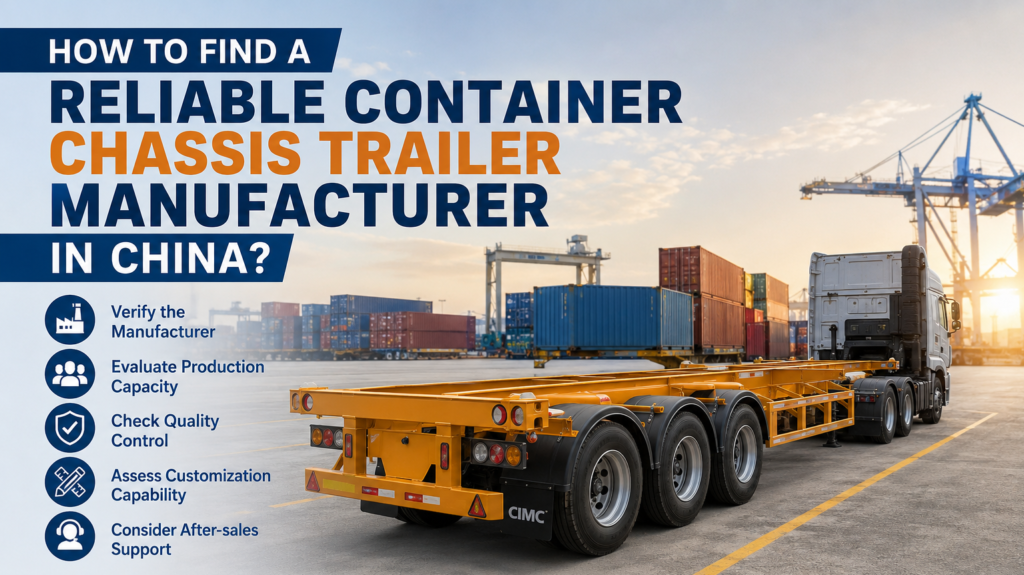
A container chassis spends its working life under repeated loading, road vibration, braking forces and changing weight distribution. A problem with frame alignment, twist-lock positioning, axle selection or welding may not be obvious when the trailer leaves the factory. It often appears later, after the chassis has been in service for months.
This is why experienced buyers tend to look beyond price.
Start With the Factory, Not the Quotation
A low quotation can be attractive, especially when several suppliers appear to be offering the same trailer. In practice, however, two container chassis that look almost identical in photographs may be very different underneath.
Before discussing the final price, it is worth establishing who actually manufactures the trailer.
Some exporters own and operate their production facilities. Others work primarily as trading companies and source trailers from different factories. Neither business model is automatically good or bad, but buyers should know who is responsible for the engineering, steel fabrication, welding, assembly and quality inspection.
A genuine manufacturer should be comfortable showing its workshop, production equipment and trailers currently being built.
Recent workshop videos are often more useful than polished marketing material. They give you a better sense of everyday production conditions, welding consistency, material handling and assembly standards.
For larger orders, a factory visit or third-party audit is even more valuable.
Engineering Matters More Than the Product Name
“40ft 3 axle container chassis” sounds like a complete specification. It is not.
There are still important decisions behind that description: axle capacity, suspension type, beam structure, kingpin position, twist-lock arrangement, brake configuration, tire size and the intended payload.
The trailer also needs to suit the market where it will operate.
A chassis built for port operations and short-distance container movement may not need the same configuration as a trailer covering long highway distances. Road quality, legal axle loads and local registration requirements can also affect the design.
This is one of the easiest ways to judge a supplier.
A manufacturer with real engineering capability will usually ask questions before finalizing the specification. The conversation should include where the trailer will be used, which containers it will carry, expected payload, road conditions and any local technical requirements.
If the supplier immediately offers one standard configuration for every country and every application, it is worth asking more questions.
Before production begins, request a technical drawing.
The drawing should confirm the chassis dimensions, axle positions, kingpin location, suspension arrangement and twist-lock positions. This is much safer than relying on a short specification sheet or WhatsApp conversation.
Look Closely at the Chassis Structure
The frame is the core of a container chassis.
For a buyer, however, evaluating the structure is more complicated than comparing steel thickness.
It is common to see suppliers promote a thicker main beam as proof of higher quality. That can be misleading. A well-designed chassis has to balance strength, tare weight, payload and fatigue resistance.
Adding more steel does not automatically create a better trailer.
What matters is how the main beams, cross members, suspension mounting areas and container locking points are designed as a complete structure.
Ask the manufacturer what steel grade is used and how the load-bearing areas are reinforced. If the trailer will work under demanding conditions, tell the engineering team before the design is confirmed.
The same applies to payload.
A chassis should not simply be advertised with the highest possible tonnage. The appropriate payload depends on the complete vehicle configuration and local operating requirements.
Welding Tells You a Lot About a Factory
Welding quality is one of the most useful things to inspect when comparing semi-trailer manufacturers.
Container chassis experience continuous vibration and repeated stress. Weak or inconsistent welds in critical areas can eventually develop cracks, particularly around suspension brackets, cross members, kingpin reinforcement and twist-lock structures.
Do not evaluate welding only from a finished trailer covered in paint.
Ask for close-up photographs of chassis currently on the production line. Bare or partially finished frames reveal much more about workmanship than completed promotional units.
A good factory should also have a defined inspection process rather than relying on the welder’s experience alone.
For fleet orders, buyers may want to agree on inspection requirements before production starts.
Compare Components on the Same Basis
This is where many quotation comparisons go wrong.
A buyer may receive three prices for what appears to be the same 3-axle container chassis. One looks significantly cheaper, but the quotations may use different axle brands, tires, suspension systems, landing gear or brake components.
The lower price is not necessarily for the same trailer.
Axles are a good example. Brand, rated capacity and service availability can influence both purchase cost and long-term maintenance. The same is true for brake chambers, ABS or EBS systems, suspension and tires.
When comparing quotations, ask each supplier to identify the major components clearly.
A useful quotation should make it easy to understand exactly which axle, suspension, tire, landing gear, kingpin and brake configuration is included.
This also makes future spare-parts purchasing easier.
Make Sure the Chassis Matches the Containers You Actually Move
Container compatibility sounds obvious, but it deserves careful confirmation.
A fixed 20ft chassis, a standard 40ft chassis and an extendable chassis solve different operational problems.
Some fleets move only one container size. Others regularly handle 20ft and 40ft units and need greater flexibility. Terminal operators may have different priorities again, especially where low-speed, high-frequency container movement is involved.
Twist-lock positioning therefore needs to be checked carefully.
Never assume that two products with the same marketing name use exactly the same container configuration.
The correct arrangement should appear on the technical drawing before manufacturing begins.
CIMC’s container chassis range includes solutions for 20ft, 40ft and 45ft container transportation, as well as fixed, skeletal and extendable chassis configurations. The appropriate model depends on how the trailer will actually be used.
Manufacturing Scale Is Useful, but Only When It Supports Consistency
Factory size alone should never be the only reason to select a supplier.
What matters is what the manufacturing system allows the company to do consistently.
CIMC Vehicles Sales Co., Ltd., established in 2011 in Yangzhou, China, integrates design, research and development, production and sales. According to the company’s information, its manufacturing facility covers approximately 590,000 square meters, including more than 160,000 square meters of factory buildings, with approximately 2,450 employees.
The company’s product range covers nine major series and more than 300 specifications across semi-trailers and specialized vehicles.
For a container chassis buyer, figures like these are relevant because production scale can support standardized processes, engineering resources, component sourcing and repeat-order capability.
This becomes particularly important when the requirement is not one trailer, but a fleet.
A buyer placing a repeat order six months later expects the new chassis to match the original specification. Consistency is one of the less visible but more valuable qualities of a mature manufacturing system.
Quality Control Should Begin Before Final Inspection
A finished trailer can look excellent and still contain problems that are difficult to see.
Quality control should therefore start much earlier than the final paint inspection.
Steel dimensions, cutting accuracy, frame alignment, welding, axle installation, brake installation and twist-lock positioning all need to be checked during production.
By the time the trailer reaches final inspection, many structural areas are already painted or assembled.
This is another reason why experienced buyers ask for production records, photographs and inspection documentation rather than relying only on a final walk-around video.
For larger international orders, independent pre-shipment inspection can be worthwhile.
The inspector can compare the finished trailers with the agreed specification, verify component brands and check important dimensions before shipment.
Corrosion Protection Deserves More Attention Than It Usually Gets
Container chassis often operate in environments that are hard on steel.
Ports and coastal logistics areas expose trailers to moisture, rain, salt, dirt and long periods outdoors. A good paint finish is therefore not only about appearance.
Surface preparation matters.
Ask how the steel is prepared before primer and topcoat are applied. Poor preparation can lead to corrosion under an otherwise attractive finish.
If your trailers will operate near the coast or in a particularly corrosive environment, discuss this with the manufacturer early. It may affect the recommended coating system.
The Destination Country Should Be Discussed Before Production
Trailer requirements vary from one market to another.
Dimensions, axle loads, braking systems, lights, reflective markings and registration requirements are not universal.
This is why “export standard” is not a very useful specification by itself.
Tell the manufacturer where the trailer will be registered and operated.
A capable supplier should be willing to discuss the relevant configuration, while the buyer or local importer should also confirm the final legal requirements with the appropriate local authority.
Compliance should be resolved before manufacturing, not after the trailer reaches the port of destination.
Customization Is Valuable When It Is Based on Engineering
One reason many international buyers source container chassis from China is flexibility.
Depending on the project, a chassis can be configured with different axles, mechanical or air suspension, tire specifications, landing gear, kingpins, braking systems, toolboxes and other accessories.
CIMC offers 20ft, 40ft and 45ft container chassis configurations, including 2-axle, 3-axle, skeletal and extendable designs for different transportation requirements.
But customization should not mean agreeing to every customer request without technical review.
Sometimes the more professional answer from a manufacturer is: “We do not recommend that configuration.”
A requested change may affect load distribution, chassis strength or compliance.
A supplier willing to challenge a poor specification can be a better long-term partner than one that simply says yes to everything.
Price Should Be Compared After the Specification Is Fixed
When buyers ask why container chassis prices in China vary so much, the answer is usually found in the details.
Steel, axles, suspension, tires, braking systems, paint, accessories and production standards all affect cost.
The best way to compare suppliers is to give each of them the same RFQ.
The destination country, container size, expected payload, axle configuration, suspension, tires, brakes and order quantity should be clearly defined.
Then compare the offers.
Otherwise, you may be comparing three different trailers that happen to share the same product name.
For commercial buyers, total operating value is usually more useful than the initial purchase price alone.
A slightly higher-cost chassis may make sense if it offers better component availability, more reliable structural performance and stronger after-sales support.
Do Not Leave After-Sales Questions Until Something Goes Wrong
Warranty discussions often receive less attention than price negotiations.
That changes quickly when a trailer develops a problem thousands of kilometers from the factory.
Before placing an order, understand how the manufacturer handles structural warranty claims, component failures and spare-parts supply.
Ask who you contact when a technical problem occurs and what information will be required to process a claim.
A useful after-sales system is not simply a sentence saying “one-year warranty.”
It should be clear who is responsible, what is covered and how replacement parts or technical guidance will be provided.
Why Buyers Consider CIMC for Container Chassis Projects
CIMC Vehicles Sales Co., Ltd. operates from Yangzhou, China and combines vehicle design, R&D, manufacturing and sales within one organization.
Its production base covers approximately 590,000 square meters, including more than 160,000 square meters of factory buildings, and employs approximately 2,450 people.
The company manufactures a broad range of semi-trailers and specialized vehicles across more than 300 specifications.
For container transport applications, available chassis solutions include models for 20ft, 40ft and 45ft containers, along with skeletal and extendable configurations.
The advantage for an international buyer is not simply having more models to choose from.
It is the ability to discuss container size, payload, road conditions, axle configuration and destination-market requirements before the final specification is confirmed.
That matters when the goal is to buy equipment that fits an actual transport operation rather than simply selecting a trailer from a catalog.
What Should You Check Before Placing an Order?
By the time you are ready to place an order, there should be very little ambiguity left.
You should know who manufactures the trailer, what the technical drawing looks like, which components will be installed, which containers the chassis will carry and how the finished equipment will be inspected.
The supplier should know your destination country and operating conditions.
Both sides should also have the same understanding of warranty, shipping and documentation.
If too many details are still being discussed after the deposit is paid, the purchasing process probably moved too quickly.
Final Thoughts
Finding a reliable container chassis trailer manufacturer in China is not mainly about finding the lowest quotation.
It is about reducing uncertainty.
A good supplier should be able to show you how the trailer is designed, where it is manufactured, which components are used and how quality is checked. The technical specification should make sense for your containers, operating environment and destination market.
For buyers comparing several manufacturers, the most useful approach is simple: compare the same specification, inspect the manufacturing process and ask detailed questions before production begins.
The answers usually tell you far more than the price.
Looking for a Container Chassis for Your Market?
CIMC Vehicles provides container chassis solutions for different transport applications, including 20ft, 40ft and 45ft container operations, skeletal chassis and extendable designs.
Share your destination country, container size, expected payload, preferred axle configuration and order quantity. Based on those details, the technical team can recommend a suitable chassis specification for your project.