
Selecting the right semi trailer plays a crucial role in improving transport efficiency, reducing operating costs, and ensuring cargo safety throughout the journey. Among all trailer types used in modern logistics, the Van Semi Trailer remains one of the most popular choices for general freight due to its fully enclosed structure, strong weather resistance, and high level of cargo protection.
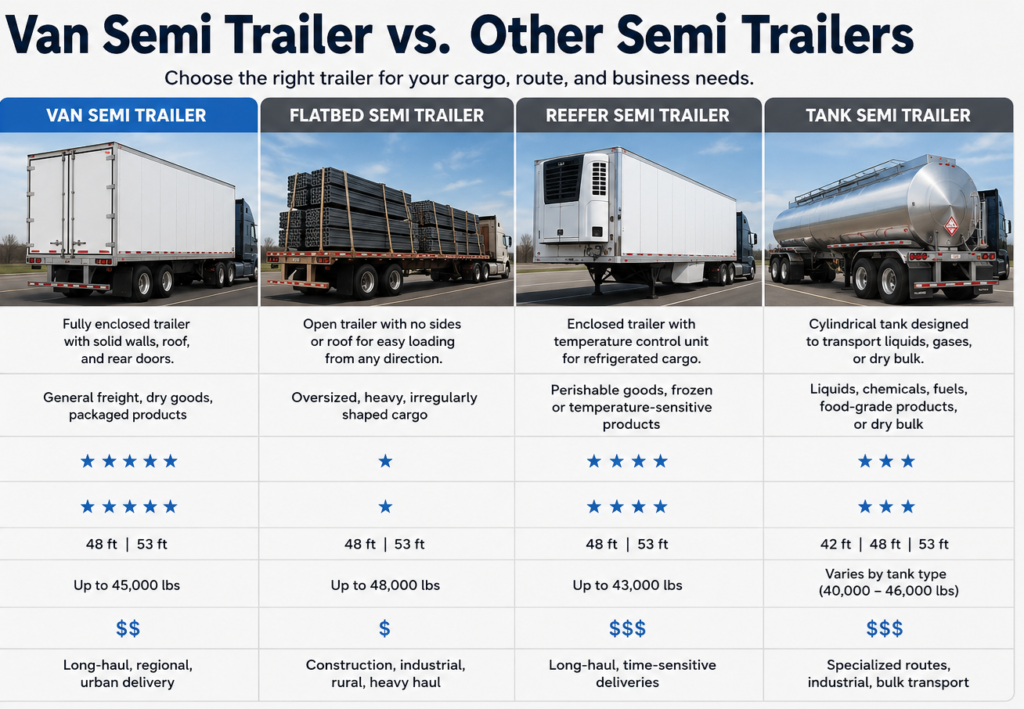
However, it is important to understand that no single trailer type fits every transportation scenario. Depending on your cargo characteristics, delivery routes, and loading requirements, other options such as Fence Semi Trailers, Curtain Side Semi Trailers, Flatbed Semi Trailers, Refrigerated Semi Trailers, and Container Chassis Trailers may offer better performance.
This guide provides a detailed comparison to help you choose the most suitable semi trailer for your business needs, especially if you are searching for a reliable van semi trailer for sale, a high-efficiency cargo transport solution, or a cost-effective logistics trailer configuration.
Van Semi Trailer vs. Other Semi Trailers
| Trailer Type | Cargo Protection | Loading Flexibility | Best For |
|---|---|---|---|
| Van Semi Trailer | High | Medium | General cargo, packaged goods, electronics, palletized freight |
| Fence Semi Trailer | Medium | High | Agricultural goods, bulk cargo, irregular loads |
| Curtain Side Semi Trailer | High | Very High | Fast distribution, palletized logistics, frequent loading |
| Flatbed Semi Trailer | Low | Very High | Heavy machinery, steel, construction materials, oversized cargo |
| Refrigerated Semi Trailer | High | Medium | Frozen food, fresh products, cold-chain logistics |
| Container Chassis | Depends on container | Medium | ISO container transport, port logistics |
Van Semi Trailer vs. Fence Semi Trailer
The Van Semi Trailer and Fence Semi Trailer are both widely used in general cargo transportation, but they serve different operational needs.
A Van Semi Trailer features a fully enclosed cargo box, which provides excellent protection against rain, dust, wind, and road debris. This makes it especially suitable for long-distance transport and high-value goods that require stable and secure conditions.
A Fence Semi Trailer, on the other hand, uses side rails or removable panels. Its semi-open structure allows for easier loading of irregular or oversized cargo, making it more flexible in certain agricultural and bulk transport scenarios.
A Van Semi Trailer is the better choice when:
- You transport palletized or boxed goods regularly
- Cargo protection and security are top priorities
- Goods are sensitive to weather or dust exposure
- You handle high-value or fragile shipments
- You need a fully enclosed transport environment
A Fence Semi Trailer is more suitable when:
- You transport agricultural or bulk materials
- Cargo shape is irregular or oversized
- Side loading and unloading are required
- Flexibility in cargo types is important
In most standard logistics operations, especially for long-distance freight transport and secure cargo delivery, the Van Semi Trailer is generally the more reliable and professional choice.
Van Semi Trailer vs. Curtain Side Semi Trailer
A Curtain Side Semi Trailer is often considered a hybrid between a van trailer and a flatbed trailer. Instead of rigid side walls, it uses flexible PVC curtains that can be opened quickly, allowing forklift access from the side.
A Van Semi Trailer, however, prioritizes full enclosure and maximum cargo protection, making it more suitable for secure transportation rather than rapid loading operations.
Advantages of Van Semi Trailer:
- Fully enclosed cargo space for maximum protection
- Strong resistance to weather and road conditions
- Higher cargo security during long-distance transport
- Ideal for stable, scheduled logistics operations
Advantages of Curtain Side Semi Trailer:
- Extremely fast side loading and unloading
- Forklift-friendly access from multiple directions
- High efficiency for palletized distribution systems
- Suitable for frequent delivery routes and warehouse logistics
If your priority is cargo safety and long-distance protection, the Van Semi Trailer is the better investment. If your business focuses on fast-moving distribution and high-frequency loading, a curtain side trailer may improve efficiency.
Van Semi Trailer vs. Flatbed Semi Trailer
A Flatbed Semi Trailer is completely open, with no roof or side walls. It is designed for cargo that cannot be loaded into enclosed spaces due to size, weight, or shape.
In contrast, a Van Semi Trailer is designed for standard freight that requires protection and controlled transport conditions.
Typical applications of Van Semi Trailer:
- Packaged consumer goods
- Electronics and appliances
- Furniture and household products
- Retail and wholesale distribution cargo
- General palletized freight
Typical applications of Flatbed Semi Trailer:
- Heavy construction machinery
- Steel coils, pipes, and beams
- Large industrial equipment
- Oversized or irregular cargo
- Construction site materials
If your cargo requires protection from rain, dust, or theft, a Van Semi Trailer is the safer and more secure option. If you frequently transport oversized industrial goods, a flatbed trailer offers greater flexibility and easier loading.
Van Semi Trailer vs. Refrigerated Semi Trailer
A Refrigerated Semi Trailer (reefer trailer) is specifically designed for temperature-controlled logistics. While both van and refrigerated trailers are enclosed, their internal systems are completely different.
A Van Semi Trailer is used for dry cargo that does not require temperature regulation. A refrigerated trailer includes insulation panels and a built-in cooling system to maintain a constant temperature.
Van Semi Trailer is ideal for:
- Dry goods transportation
- General freight logistics
- Electronics and machinery
- Furniture and retail products
- Non-perishable cargo
Refrigerated Semi Trailer is ideal for:
- Frozen food transportation
- Fresh fruits and vegetables
- Meat, seafood, and dairy products
- Pharmaceutical and medical supplies
- Cold-chain logistics operations
If your cargo does not require temperature control, a Van Semi Trailer is significantly more cost-efficient in both purchase and operation. For cold-chain supply chains, a reefer trailer is essential.
Van Semi Trailer vs. Container Chassis
A Container Chassis Semi Trailer is designed exclusively for transporting standardized shipping containers such as 20ft, 40ft, or high-cube containers.
Unlike a Van Semi Trailer, it does not carry loose cargo directly. Instead, containers are locked onto the chassis using twist-lock mechanisms.
Van Semi Trailer is used for:
- Direct cargo loading and unloading
- Warehouse-to-warehouse transport
- Domestic logistics distribution
- General freight operations
- Flexible cargo handling
Container Chassis is used for:
- Port container transportation
- International shipping logistics
- Intermodal transport systems
- Standard ISO container movement
The key difference is simple: a Van Semi Trailer carries goods directly, while a container chassis carries standardized containers.
Key Factors When Choosing a Semi Trailer
Before selecting a trailer type, it is important to evaluate several practical and operational factors.
1. Cargo Type
Different cargo requires different trailer structures. Dry goods, bulk materials, containers, and temperature-sensitive products all require specialized solutions.
2. Load Capacity and Axle Configuration
Payload requirements directly affect axle number, suspension type, tire selection, and overall trailer durability.
3. Loading and Unloading Method
Consider whether your operation requires rear loading, side access, forklift handling, or crane lifting.
4. Cargo Protection Level
If your goods require protection from weather, dust, or theft, a fully enclosed Van Semi Trailer is often the most secure option.
5. Road and Transport Conditions
Long-distance highways, rough terrain, and urban delivery routes all influence trailer design and durability requirements.
6. Local Regulations
Each country has specific rules regarding trailer dimensions, axle load limits, braking systems, and road safety compliance.
Which Semi Trailer Should You Choose?
There is no universal solution when it comes to semi trailers. Each type is designed for a specific transport application.
- Van Semi Trailer: Best for secure, enclosed general freight transport
- Fence Semi Trailer: Best for flexible bulk and agricultural cargo
- Curtain Side Semi Trailer: Best for fast loading and distribution efficiency
- Flatbed Semi Trailer: Best for heavy and oversized industrial cargo
- Refrigerated Semi Trailer: Best for cold-chain and temperature-sensitive goods
- Container Chassis: Best for container-based logistics and port transport
For most businesses involved in general cargo transportation, long-distance freight, and secure logistics operations, the Van Semi Trailer remains one of the most balanced and cost-effective solutions available.
Choosing the Right Van Semi Trailer for Your Business
When selecting a Van Semi Trailer, it is important to consider not only the trailer type but also the detailed configuration, including axle brand, suspension system, tire specification, loading capacity, and body material.
A well-configured trailer can significantly improve fuel efficiency, reduce maintenance costs, and extend service life. That is why many buyers searching for a durable van semi trailer for long-distance transport, or a customized enclosed cargo trailer solution, choose to work closely with experienced manufacturers.
Before making a final purchase decision, clearly define your cargo requirements, operating environment, and transport frequency. This ensures that your Van Semi Trailer is properly designed for safe, efficient, and long-term use in real-world logistics operations.
FAQ
1. What is a Van Semi Trailer mainly used for?
A Van Semi Trailer is mainly used for transporting general dry cargo such as packaged goods, electronics, furniture, and palletized freight. It is widely used in domestic logistics and long-distance transportation due to its fully enclosed structure.
2. Is a Van Semi Trailer better than a Flatbed Semi Trailer?
It depends on the cargo type. A Van Semi Trailer is better for protected and enclosed cargo, while a Flatbed Semi Trailer is better for oversized, heavy, or irregular industrial goods.
3. What is the difference between a Van Semi Trailer and a Curtain Side Trailer?
A Van Semi Trailer is fully enclosed for maximum protection, while a Curtain Side Trailer allows faster side loading and unloading. The choice depends on whether you prioritize security or loading efficiency.
4. Can a Van Semi Trailer be used for international transport?
Yes, Van Semi Trailers are commonly used in cross-border and international logistics, especially for dry cargo that requires protection during long-distance transport.
5. How do I choose the right Van Semi Trailer manufacturer?
You should consider manufacturing experience, customization options, axle and suspension quality, after-sales support, and compliance with international transport standards when selecting a supplier.