
When comparing semi-trailers for commercial transport, buyers often pay close attention to payload capacity, axle configuration, suspension, and tire specifications. The braking system deserves the same attention, particularly when the trailer will carry heavy machinery, steel products, construction materials, or other substantial loads.
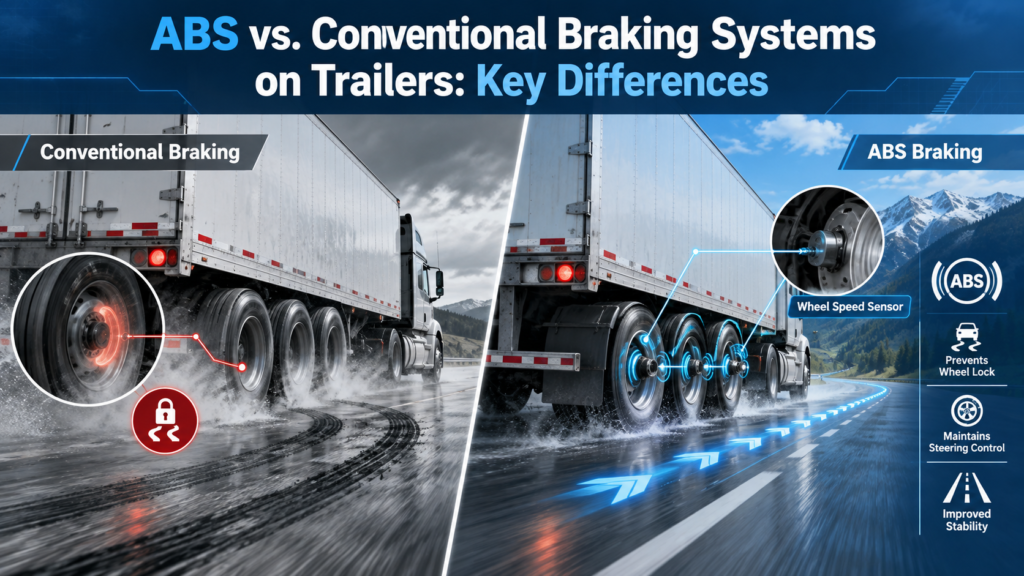
The main difference between ABS and conventional braking systems on trailers is how they respond when a wheel is about to lock during braking. Both systems use brakes to slow the vehicle, but a trailer equipped with ABS can monitor wheel speed and adjust brake pressure when necessary. This additional control can help maintain directional stability, especially when tire grip is limited.
Understanding how the two systems work, what maintenance they require, and which regulations apply can help transport companies make better equipment decisions.
What Is a Conventional Trailer Braking System?
Most heavy-duty semi-trailers use air brakes. When the driver applies the brakes, compressed air operates the brake chambers, which apply force to the foundation brakes at the wheels. Depending on the trailer design, the system also includes air reservoirs, relay valves, control valves, brake lines, and other pneumatic components.
A conventional trailer braking system can provide effective braking when properly specified and maintained. The limitation is that a system without ABS cannot electronically regulate brake pressure in response to an impending wheel lock.
If the braking force exceeds the grip available between a tire and the road, a wheel may stop rotating while the vehicle is still moving. This can reduce directional control and increase the risk of skidding. The risk becomes more significant during hard braking, particularly on wet or slippery surfaces.
It is important to distinguish between conventional air brakes and ABS. Air brakes describe how braking force is applied, while ABS is an electronic control function that can be added to the underlying braking system. A trailer can therefore use air brakes with or without ABS, subject to the applicable vehicle requirements.
What Is a Trailer ABS Braking System?
A trailer anti-lock braking system (ABS) adds electronic control to the existing brakes. A typical system uses wheel-speed sensors, a toothed tone ring, an electronic control unit (ECU), and ABS modulator valves.
As the wheels rotate, the sensors detect changes in speed and send signals to the ECU. If the system identifies a wheel approaching lockup, the modulator valves adjust brake pressure to help the wheel continue rotating. The system can repeat this process as braking conditions change.
The arrangement varies by manufacturer and trailer configuration. Designations such as 2S/1M, 2S/2M, and 4S/2M describe different combinations of wheel-speed sensors and modulator valves. In these designations, S refers to sensors and M refers to modulators. The appropriate configuration depends on the axle arrangement, brake layout, and control strategy specified for the vehicle.
ABS does not replace the foundation brakes or automatically increase their mechanical capacity. Its role is to manage wheel lock while the underlying brakes continue to provide the force needed to slow the trailer.
For fleet operators, the distinction matters most when braking conditions change suddenly. ABS can help the driver maintain directional control, but it cannot compensate for excessive speed, unsuitable tires, worn brake components, or an overloaded trailer.
ABS vs. Conventional Trailer Brakes: What Are the Main Differences?
The two systems use the same basic braking principles, but ABS adds a layer of electronic monitoring and control. The practical differences are easiest to see when comparing wheel-lock control, components, maintenance, and regulatory requirements.
| Feature | Conventional Braking Without ABS | Trailer Braking With ABS |
|---|---|---|
| Basic braking | Uses the normal brake system to slow the trailer | Uses the same basic brakes with additional electronic control |
| Wheel-lock control | No electronic anti-lock regulation | Monitors wheel speed and adjusts brake pressure when needed |
| Directional control | Locked wheels can reduce stability | Helps maintain wheel rotation and directional control |
| Main components | Pneumatic, mechanical, and friction-brake components | Adds wheel-speed sensors, an ECU, and ABS modulator valves |
| Maintenance | Requires regular brake and air-system inspections | Requires conventional brake servicing plus ABS checks |
| Fault diagnosis | Focuses on mechanical, pneumatic, and brake-related faults | Also involves sensors, wiring, electrical connections, and fault indicators |
| Compliance | Depends on the applicable vehicle requirements | Must meet the ABS requirements applicable to the vehicle and market |
ABS should not be treated as a guarantee of shorter stopping distances. Actual braking performance depends on road surface, tire grip, load distribution, vehicle speed, brake condition, and the design of the complete tractor-trailer combination.
Does Trailer ABS Improve Braking on Wet Roads and Under Heavy Loads?
On a dry road during normal braking, a properly maintained conventional system may provide effective braking without ABS needing to intervene. The difference becomes more relevant when tire grip decreases or the driver has to brake hard.
On wet or slippery roads, a functioning trailer ABS system can adjust brake pressure when it detects an impending wheel lock. This helps the wheels retain rotation and can support directional stability. Drivers must still reduce speed and leave sufficient following distance because ABS cannot eliminate the risks associated with poor traction.
Loose surfaces can present different braking challenges. The effect of ABS on stopping distance varies with the surface and vehicle configuration, so buyers and operators should follow the vehicle manufacturer’s guidance rather than assume that ABS always produces a shorter stop.
Heavy cargo introduces another set of considerations. Steel products, construction machinery, and other dense loads can create substantial or uneven axle loads. If the cargo is poorly positioned or the trailer is overloaded, braking performance may be affected regardless of whether ABS is installed.
For this reason, ABS should be considered alongside axle ratings, tires, suspension, brake condition, and the intended operating environment. A correctly specified braking system is only one part of safe heavy-duty transportation; proper loading and vehicle maintenance remain equally important.
Trailer ABS Warning Light: Common Causes and Checks
A trailer ABS warning light provides information about the system’s operating status. Its location and behavior depend on the vehicle and ABS design, so the manufacturer’s instructions should be followed when checking it.
On systems that use a brief lamp test when power is supplied, the ABS indicator normally illuminates during the self-check and then switches off if no fault is detected. If the light remains on, or fails to illuminate when expected, the system may need inspection. The exact behavior varies by system.
Why Does a Trailer ABS Warning Light Stay On?
A warning light can be associated with several types of faults. A damaged or incorrectly positioned wheel-speed sensor may provide an unreliable signal. Corrosion, loose connectors, or damaged wiring can interrupt communication or power. Problems with an ABS modulator valve or an electrical supply may also prevent the system from operating correctly.
The warning light alone does not identify the failed component. A technician may need to check the sensor and tone ring, inspect wiring and connectors, and retrieve fault codes using compatible diagnostic equipment.
If the trailer ABS warning light stays on, consult the manufacturer’s instructions and arrange a qualified inspection. On some systems, an ABS fault may disable the anti-lock function while the basic braking system remains available, but this should never be assumed without checking the specific vehicle. The condition of the conventional brakes must also be verified.
For commercial fleets, recording recurring warning lights and repairs can help identify persistent problems, especially when trailers operate across different regions or are serviced by multiple workshops.
Trailer ABS Maintenance: Sensors, Wiring, and Brake Inspections
Trailer ABS maintenance should be carried out alongside routine brake servicing. Checking electronic components does not replace the need to inspect the air system and mechanical brakes.
Wheel-speed sensors and tone rings deserve particular attention because the ECU relies on accurate wheel-speed information. Sensor position, damaged wiring, corrosion, and problems around the tone ring can interfere with the signal used by the system. Electrical connectors and modulator components should also be checked according to the manufacturer’s procedures.
The conventional braking system needs its own inspection schedule. Air lines, brake chambers, valves, brake linings, drums or discs, tires, and brake adjustment should be checked at the intervals specified by the manufacturer and applicable regulations.
When a fault occurs, diagnosing the cause is preferable to replacing parts based on guesswork. Compatible diagnostic equipment and the manufacturer’s fault-code guidance can help distinguish a sensor problem from an electrical, modulator, or other system fault.
Maintenance requirements can vary between ABS systems. Before purchasing a trailer for an export market, it is worth confirming which replacement components are used, whether suitable diagnostic support is available locally, and how easily spare parts can be obtained.
ABS Requirements for Semi-Trailers: What Export Buyers Need to Know
ABS requirements depend on the destination country, vehicle category, production date, and applicable regulations. Buyers should confirm these details before finalizing a trailer specification rather than assume that the same configuration is accepted in every market.
In the United States, Federal Motor Vehicle Safety Standard No. 121 covers air-brake system requirements for applicable vehicles, including relevant ABS provisions. Buyers can consult the current regulation at 49 CFR § 571.121 — Air Brake Systems.
For markets applying United Nations vehicle regulations, UNECE Regulation No. 13 addresses braking requirements for heavy vehicles and trailers. The applicable provisions depend on the vehicle category and regulatory framework.
These regulations should be treated as market-specific references, not as a single rule for every semi-trailer worldwide. Export buyers should confirm the required braking equipment, electrical connections, documentation, and approval process with the manufacturer and the relevant authority or importer in the destination market.
A trailer specification that meets the requirements of one country may not automatically be suitable for another. Resolving these questions before production can help avoid configuration changes, documentation problems, and delays during vehicle approval or registration.
What Should Buyers Check Before Ordering a Semi-Trailer with ABS?
When comparing semi-trailer models, start with the intended cargo, expected axle loads, operating environment, and destination-country requirements. These factors help determine the braking configuration needed for the application.
The tractor and trailer must also work together as a compatible combination. Buyers should confirm the relevant air connections, electrical supply, ABS interfaces, and other specifications with the manufacturer. Where both vehicles have ABS, the complete arrangement should be checked against the applicable system requirements.
It is also useful to look beyond the initial purchase price. Ask about compatible replacement sensors and valves, diagnostic support, maintenance documentation, warranty conditions, and parts availability in the destination market. These details can affect both maintenance costs and the time required to return a trailer to service.
When comparing quotations, make sure the braking-system specification is clearly stated rather than relying on a general description such as “ABS equipped.” Confirm the actual equipment included in the order and whether the configuration meets the requirements of the intended market.
Buyers comparing different semi-trailer models and configurations should confirm the braking equipment fitted to the selected model before placing an order.
Frequently Asked Questions
Does trailer ABS always reduce stopping distance?
No. Trailer ABS is designed to help prevent wheel lock and support directional control during braking. Stopping distance still depends on road conditions, tire grip, vehicle speed, load, and brake condition. ABS should not be used as a reason to drive faster or follow other vehicles more closely.
Can a trailer have air brakes without ABS?
Yes, technically, a trailer can have an air-brake system without ABS. Whether that configuration is permitted depends on the vehicle category, applicable regulations, and destination market. Buyers should verify the requirements before selecting the braking specification.
What does it mean if the trailer ABS warning light stays on?
A warning light that remains on may indicate an ABS fault, but the cause cannot be identified from the light alone. Check the manufacturer’s instructions and arrange a qualified inspection using the appropriate diagnostic procedure.
Is ABS mandatory on all semi-trailers?
No single rule applies to every semi-trailer worldwide. Requirements depend on the destination market, vehicle category, production date, and applicable regulations. Buyers should confirm the current requirements before ordering a trailer for export.
Final Considerations
ABS adds electronic wheel-lock control to a trailer’s existing braking system. Compared with conventional braking without ABS, it can help maintain wheel rotation and directional control when a wheel is at risk of locking. Its effectiveness still depends on correct installation, suitable tires, proper loading, and regular maintenance.
For trailer buyers, the decision should be based on the vehicle specification, operating conditions, tractor-trailer compatibility, maintenance support, and destination-market requirements. Confirming these details before purchase helps ensure that the braking system matches the trailer’s intended use.