
China has become an important sourcing destination for companies looking to purchase commercial trailers and bulk material transportation equipment. For cement distributors, construction contractors, and transport operators, buying a cement tanker trailer from China offers access to a wide range of models, equipment configurations, and manufacturing options.
But finding a suitable trailer takes more than comparing quotations. Tank capacity, loading weight, discharge performance, axle configuration, and local road regulations all affect whether a particular model will work for your business. A trailer that looks suitable on paper may not perform as expected if its compressor system or tank design does not match your operating conditions.
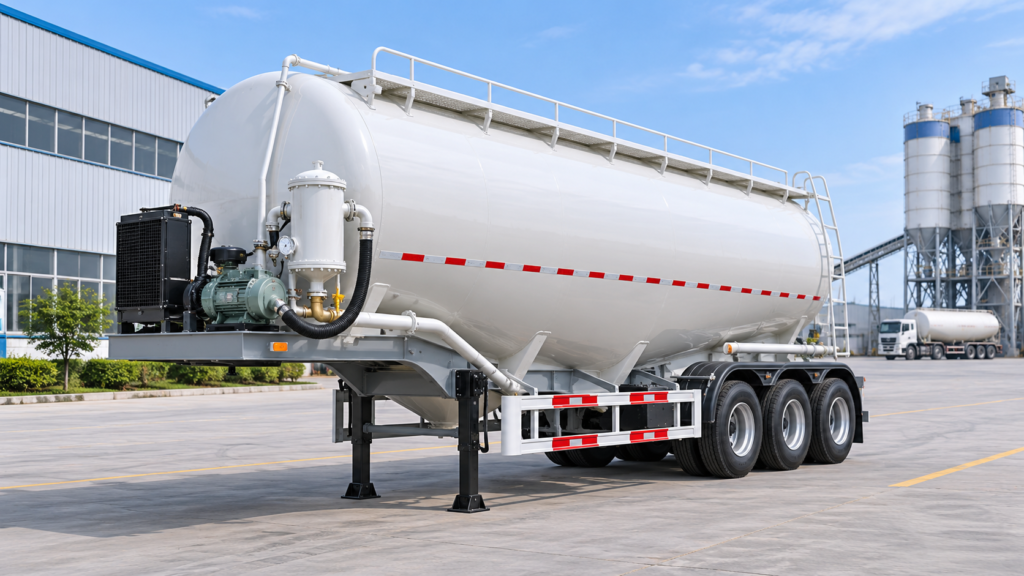
If you are planning to buy a cement tanker trailer in China, this guide covers the main points to consider before placing an order, including trailer types, technical specifications, prices, manufacturer selection, quality inspection, and international shipping.
1. What Is a Cement Tanker Trailer and How Does It Work?
A cement tanker trailer is a specialized semi-trailer used to transport cement and other dry bulk materials, including fly ash, lime powder, and similar industrial powders. It is also commonly called a bulk cement tanker trailer or pneumatic bulk tanker.
Unlike a flatbed or box trailer, a cement tanker trailer has an enclosed tank and a pneumatic unloading system. Instead of unloading bags or handling the material manually, operators use compressed air to move the powder through pipelines into a storage silo.
This makes the trailer particularly useful for cement plants, concrete batching facilities, construction material suppliers, and transport companies handling regular bulk powder deliveries.
Main Components of a Cement Tanker Trailer
Although designs vary between manufacturers, most cement tanker trailers share several basic components.
The tank body holds the dry bulk material during transportation. Its shape and internal arrangement affect how easily the material moves toward the discharge outlets.
The air compressor supplies compressed air for unloading. Depending on the configuration, it may be driven by the tractor’s power take-off system or by an independent power source.
Inside the tank, the aeration system helps loosen the powder so it can flow toward the discharge points. Discharge pipelines then carry the material to the receiving silo.
The trailer also includes a chassis, axles, suspension, tires, and braking system. These components carry the load and keep the vehicle stable during road transportation. Pressure gauges, safety valves, manholes, and other accessories are fitted according to the tank design and operating requirements.
When comparing a bulk cement tanker trailer, look at the complete system rather than focusing on the tank alone. The compressor, aeration arrangement, and discharge pipeline need to work together.
How Does a Pneumatic Cement Tanker Trailer Work?
The unloading process starts when compressed air enters the tank through the aeration system. This helps loosen the cement powder and allows it to move toward the discharge outlets.
The material then travels through the discharge pipeline into a storage silo or another designated receiving facility. The operator controls the unloading process according to the equipment instructions and working conditions.
Unloading time is not determined by tank capacity alone. Compressor output, pipeline length, material condition, and the layout of the receiving facility can all make a difference.
For this reason, buyers should discuss their actual unloading conditions with the manufacturer before selecting a pneumatic cement tanker trailer. A system designed for a short pipeline at a cement plant may not be the right choice for a different installation.
2. Different Types of Cement Tanker Trailers Available in China
Chinese manufacturers produce cement tanker trailers in different tank designs and chassis configurations. The right model depends on the type of material being transported, the required payload, and the unloading equipment available at the destination.
Before requesting quotations, it is worth understanding the main options.
V-Type Cement Tanker Trailer
A V-type cement tanker trailer has a tank structure designed to guide bulk powder toward the discharge area. The internal arrangement helps direct the material toward the outlets during pneumatic unloading.
This design is used for transporting cement and other dry powder materials. However, the actual unloading performance depends on more than the tank’s external shape. Internal aeration components, discharge outlet positions, and pipeline arrangements also need to be considered.
If you are comparing V-type cement tanker trailers, ask suppliers for tank drawings and details of the discharge system. These provide a much clearer picture of the design than product photographs alone.
W-Type Cement Tanker Trailer
W-type cement tanker trailers use a different tank profile and internal arrangement. Depending on the manufacturer’s design, the tank may have multiple material flow channels or discharge areas.
Buyers may come across both V-type and W-type models when searching for a bulk cement tanker trailer in China. The names describe different tank designs, but they do not automatically indicate which model offers better performance.
Ask the manufacturer how the internal structure works, how many discharge outlets are fitted, and whether the proposed design is suitable for your material and unloading setup.
Cement Tanker Trailers with Different Axle Configurations
Axle configuration affects how a cement tanker trailer distributes its weight on the road. Common options include two-axle, three-axle, and four-axle designs.
A 2 axle cement tanker trailer may suit certain lighter-duty applications, while a 3 axle cement tanker trailer is widely used in markets where this configuration meets local transportation requirements. Four-axle models may be considered for applications that require a different load distribution arrangement.
The decision should be based on the permitted axle loads, gross vehicle weight, tractor specifications, and road conditions in the destination country.
Adding more axles does not necessarily increase the legal payload. Local regulations determine how much weight the complete vehicle can carry.
Customized Bulk Cement Tanker Trailers
Standard models are not always suitable for every market. Some buyers need different tank dimensions, axle brands, tire sizes, suspension systems, or unloading arrangements to match their existing transport fleet.
Chinese manufacturers can often customize a bulk cement tanker trailer according to these requirements. Before requesting a design, prepare information about the material, expected payload, road conditions, tractor model, and unloading facilities.
Providing these details at the beginning makes it easier for the manufacturer to recommend a suitable configuration and prepare an accurate quotation.
3. How to Choose the Right Cement Tanker Trailer Specifications
Two cement tanker trailers may look similar but have quite different specifications. The differences become more noticeable when you compare the tank structure, compressor system, axle capacity, and overall vehicle weight.
For overseas buyers, the goal is to select a configuration that works under local operating conditions rather than simply choosing the largest model available.
Choose the Right Tank Capacity
Tank capacity is usually one of the first details buyers ask about. However, it is worth separating tank volume from actual payload.
Tank volume is measured in cubic meters, while payload is measured in tons. How much cement can be carried depends on the bulk density of the material, the trailer’s tare weight, and the maximum permitted gross vehicle weight.
For example, a larger tank does not automatically mean a higher legal payload. If the material is relatively dense, the trailer may reach its permitted weight limit before the tank is completely filled.
When comparing bulk cement tanker trailer capacity, consider how much material you normally transport per trip, the distance between loading and unloading points, and the weight limits on your regular routes.
It is also useful to check the loading facilities at the cement plant. The tank should be compatible with the available loading equipment and unloading connections.
Check the Tank Material and Thickness
The tank body needs to withstand the demands of repeated loading, transportation, and unloading. Steel grade, plate thickness, welding quality, and structural design all contribute to its durability.
Ask the cement tanker trailer manufacturer to specify the material used for the tank body and provide the relevant technical drawings. You should also confirm the thickness of the different tank sections rather than assuming that every part uses the same plate thickness.
A heavier tank is not always a better choice. Excessive structural weight can reduce the available payload, while an unsuitable design may create maintenance problems. The specification should follow the manufacturer’s engineering design and the applicable safety requirements.
Pay attention to the internal structure and welded joints as well. These details are difficult to judge from exterior photographs, so production records and inspection results are useful when evaluating a bulk cement tanker body.
Select the Right Axles and Suspension System
The axle configuration should match the expected load and the regulations in your market.
When reviewing a 3 axle cement tanker trailer specification, check the axle brand, rated capacity, brake configuration, tire size, and suspension type. These details should be listed clearly in the quotation.
Mechanical suspension is commonly selected for its straightforward structure and maintenance requirements. Air suspension may be suitable for certain operating conditions, depending on local regulations and the buyer’s requirements.
Road conditions also deserve attention. A trailer used mainly on well-maintained highways may need a different configuration from one operating regularly on rough roads or construction sites.
Choose a Suitable Air Compressor System
The air compressor has a direct effect on how the trailer unloads. If its output does not match the tank and discharge arrangement, unloading may take longer than expected.
When comparing cement tanker trailer air compressors, check the rated air delivery, working pressure, drive method, and compatibility with the pneumatic system.
The pipeline layout matters too. A long discharge line or a receiving silo located at a different height can affect the unloading requirements.
Ask the supplier to explain the proposed pneumatic cement tanker trailer discharge system and confirm that it has been selected for your intended application. If possible, provide details of your receiving silo and typical unloading conditions before the equipment is finalized.
Consider Local Road and Legal Requirements
A trailer built for one country may not be suitable for registration in another without changes.
Before ordering, check the rules covering trailer length, width, height, gross vehicle weight, axle loads, braking equipment, lighting, and vehicle approval. Requirements vary between countries and sometimes between regions.
You should also check whether the trailer’s connection system and dimensions are compatible with your tractor.
Confirming these details before production is much easier than making modifications after the trailer arrives at the destination port.
4. How Much Does a Cement Tanker Trailer Cost in China?
There is no fixed price for every cement tanker trailer. The final quotation depends on the tank capacity, steel specifications, chassis configuration, compressor system, axle brand, tires, and other equipment.
A standard model and a customized trailer may have very different prices, even if their external appearance is similar.
If you are comparing cement tanker trailer prices in China, ask each supplier to quote against the same technical specification. This makes it easier to identify where the price differences come from.
Factors That Affect Cement Tanker Trailer Prices
Tank capacity and tank design are two major cost factors. A larger tank may require more materials and a different structural arrangement.
Steel grade and plate thickness also influence the manufacturing cost. The same applies to axle brands, suspension systems, brake components, and tires.
The pneumatic equipment is another part of the quotation worth checking carefully. Different compressor brands and specifications can result in different prices. Additional valves, pipelines, and accessories may also affect the total cost.
Finally, customization can add to the price. Special dimensions, non-standard configurations, or requirements specific to the destination market may involve additional engineering and production work.
Rather than asking only for the cheapest bulk cement tanker trailer, buyers should compare the equipment included in each offer and consider the expected operating life.
Standard vs. Customized Cement Tanker Trailers
A standard cement tanker trailer is often a practical option when the manufacturer’s existing specifications already match your requirements. It can simplify the ordering process and reduce the need for design changes.
Customized cement tanker trailers are worth considering when the trailer needs to work with specific loading facilities, local regulations, or an existing fleet.
For example, a buyer may need a particular axle brand, a different tank volume, or a compressor arrangement compatible with existing equipment.
The best option depends on how closely the standard model matches your operating conditions. Customization should solve a real requirement rather than add equipment that will not be used.
What Is Included in a Cement Tanker Trailer Quotation?
A quotation should provide enough detail for you to understand exactly what you are buying.
Before confirming an order, check that the supplier has listed:
- Tank volume, material, and plate thickness.
- Overall trailer dimensions and tare weight.
- Axle brand, quantity, and rated capacity.
- Suspension and braking system.
- Tire brand, size, and quantity.
- Air compressor and pneumatic unloading equipment.
- Standard accessories and spare parts.
- Warranty conditions and after-sales support.
- Production lead time and payment terms.
- Shipping arrangements and applicable trade terms.
Also confirm whether the price is EXW, FOB, or CIF. These terms cover different costs and responsibilities, so two quotations should not be compared directly unless their delivery conditions are understood.
5. How to Find a Reliable Cement Tanker Trailer Manufacturer in China
Choosing a supplier is not just about finding a company with an attractive product catalog. You need to know whether it can manufacture the configuration you require, maintain consistent quality, and provide support after delivery.
There are many companies selling trailers in China, including manufacturers and trading companies. Both may be able to supply products, but their production arrangements and technical capabilities can differ.
Check the Manufacturer’s Factory and Production Capacity
Start by checking the company’s actual manufacturing facilities. For a cement tanker trailer factory in China, relevant areas include tank fabrication, welding, surface treatment, chassis assembly, and final inspection.
A factory visit is useful if you can arrange one. If traveling to China is not practical, request a live video tour showing the production workshop and the equipment used to manufacture the trailer.
It is also worth asking whether the company manufactures the tank body itself or purchases it from another supplier. This helps you understand which parts of the production process it controls.
A manufacturer with experience in bulk cement tanker trailer production should be able to discuss tank design, unloading arrangements, and common configuration requirements in practical terms.
Review Product Quality and Certifications
Do not rely on a certificate image or a general statement that the product meets international standards. Ask which standards and approvals apply to the exact trailer model you intend to purchase.
Review the manufacturer’s quality control procedures, welding inspection records, material documentation, and relevant test reports.
The required vehicle approval or certification depends on the destination market and the vehicle category. Confirm the requirements with the relevant local authority or an authorized inspection organization before ordering.
Evaluate Export Experience and Customer Support
A cement tanker trailer exporter from China should be familiar with the practical requirements of international orders, including production coordination, export documentation, and shipping arrangements.
Ask whether the supplier has experience exporting to your country or to markets with similar regulations. Previous export experience does not guarantee that every model will meet your local requirements, but it can help reduce communication and documentation problems.
After-sales service deserves the same attention as the initial sale. Confirm the warranty period, availability of replacement parts, and how technical questions will be handled once the trailer is in operation.
Compare Multiple Suppliers Before Making a Decision
It is sensible to request quotations from several China cement tanker trailer suppliers. The key is to give each company the same requirements.
Compare tank volume, tare weight, axle configuration, compressor specifications, tire brands, and included accessories. Also look at the production schedule, warranty, and delivery arrangements.
If one quotation is much lower than the others, ask the supplier to explain the difference. It may reflect a different component brand, a lighter specification, or equipment that has not been included.
A clear and detailed quotation is often a better starting point than a very low headline price.
6. What Should You Check Before Ordering a Cement Tanker Trailer?
Before the trailer leaves the factory, arrange an inspection against the specifications agreed in the purchase contract.
This does not have to be complicated, but it should cover the main structural and mechanical components. Finding a problem before shipment is generally easier than dealing with it after the trailer reaches the destination.
Tank Body Inspection
Check the tank dimensions, material specifications, external finish, manholes, and discharge outlets against the approved drawings.
Look for visible deformation, damage, or signs of poor workmanship. Where relevant, review the manufacturer’s inspection records for the tank and its pressure-related components.
Welding and Structural Quality
Inspect the visible weld seams and tank support structure. Look for cracks, obvious gaps, or inconsistent workmanship.
The inspection method should follow the applicable technical requirements. Where necessary, ask the manufacturer for non-destructive testing records or other relevant quality documentation.
The chassis mounting points and tank supports should also match the approved design.
Pneumatic Discharge System Testing
The air compressor, valves, gauges, pipelines, and discharge outlets should be checked before delivery.
Ask the manufacturer to demonstrate the system and explain the normal operating procedure. If a discharge test is part of the agreed inspection, confirm that the results meet the specified requirements.
This is particularly useful for buyers who have not previously operated a pneumatic cement tanker trailer.
Axles, Tires, Brakes, and Suspension Inspection
Check the installed axle brands, tire specifications, brake components, and suspension arrangement against the order.
Also inspect the lighting system, electrical connections, safety accessories, and other equipment required for road use.
Final Inspection Before Shipment
The final inspection should cover the complete trailer, not just the tank body.
Check the vehicle identification information, exterior condition, accessories, spare parts, and documents. Keep a copy of the approved specification sheet and inspection records for reference.
If you cannot visit the factory, a third-party inspection company can carry out the checks on your behalf. A live video inspection is another option, although it may not replace formal testing where this is required.
7. How to Ship a Cement Tanker Trailer from China to Your Country
Once production and inspection are complete, the trailer can be prepared for export. The shipping method needs to be confirmed early because trailer dimensions and vessel availability can affect both cost and delivery arrangements.
Choose the Right Shipping Method
RORO shipping is often considered for complete trailers that can be driven or moved onto a suitable vessel. It can be a practical option when the route and port facilities support this type of cargo.
Breakbulk shipping may be suitable for oversized trailers or cargo that cannot be handled through standard container services.
Flat rack or other special equipment may also be considered, depending on the trailer dimensions and the carrier’s requirements. Not every cement tanker trailer can be shipped using the same method, so the shipping company should confirm feasibility before the order is finalized.
Ask your supplier for the trailer’s overall length, width, height, tare weight, and loading details. These figures are needed when requesting a freight quotation.
Prepare Export and Shipping Documents
The documents required for importing a cement tanker trailer vary by destination country and shipping arrangement.
Common documents may include:
- Commercial Invoice.
- Packing List.
- Bill of Lading.
- Certificate of Origin, where required.
- Export customs declaration.
- Vehicle technical specifications.
- Applicable inspection or conformity documents.
Before shipment, check the import requirements with your customs broker or local authorities. Vehicle registration and conformity documents may need to be prepared separately from ordinary shipping paperwork.
Consider Shipping Costs and Delivery Time
The factory price is only one part of the total import cost.
You may also need to budget for inland transportation in China, export handling, ocean freight, insurance, destination port charges, customs duties, taxes, and delivery to your final location.
Transit time depends on the destination port, shipping route, vessel schedule, and port handling arrangements. Ask the supplier or freight forwarder for an estimated schedule and clarify which charges are included in the quotation.
8. Step-by-Step Process for Buying a Cement Tanker Trailer in China
For first-time importers, it helps to handle the purchase in a clear sequence. This reduces the chance of missing important details between the initial inquiry and final delivery.
Step 1: Define Your Transportation Requirements
Decide what material you will carry, the approximate volume required per trip, and the distance between loading and unloading points. Check your local vehicle weight and dimension limits as well.
Step 2: Select the Trailer Type and Specifications
Choose a suitable tank design, capacity, axle configuration, and pneumatic system. Make sure the proposed trailer can work with your tractor and receiving facilities.
Step 3: Contact Chinese Manufacturers
Send the same basic requirements to several manufacturers. Ask for product drawings, configuration details, factory information, and export experience.
Step 4: Compare Quotations
Review the complete specifications rather than comparing prices alone. Clarify any differences in materials, components, accessories, warranty, and delivery terms.
Step 5: Confirm the Order
Before making the deposit, approve the technical drawings and written configuration list. The purchase agreement should also cover payment terms, production time, inspection arrangements, and warranty conditions.
Step 6: Inspect the Trailer Before Shipment
Check the finished trailer against the approved specifications. Arrange a factory visit or independent inspection if necessary.
Step 7: Arrange Shipping and Customs Clearance
Confirm the shipping method, export documents, freight charges, and destination import requirements. Keep in contact with the supplier and customs broker until delivery is completed.
9. Common Mistakes to Avoid When Buying a Cement Tanker Trailer
A few purchasing mistakes can create problems long after the trailer has left the factory. Most can be avoided by checking the technical details and commercial terms before placing the order.
Choosing a Cement Tanker Trailer Based on Price Alone
A low quotation may look attractive, but it does not tell you whether the tank material, compressor, axles, or other components meet your requirements.
Compare complete specifications and ask suppliers to explain any significant price differences. A trailer that costs less initially may involve higher maintenance or operating expenses later.
Ignoring Local Transportation Regulations
Do not assume that a standard Chinese configuration can automatically be registered in your country.
Check the permitted vehicle dimensions, axle loads, braking requirements, and approval procedures before production. This is especially important when ordering a customized trailer.
Overlooking Air Compressor Performance
The compressor and discharge system need to match the tank design and the unloading conditions.
Ask about air delivery, working pressure, power source, and pipeline requirements. A system that is not properly matched may lead to slow or unreliable unloading.
Failing to Check Manufacturer Credentials
Product photographs and online listings are not enough to establish a supplier’s manufacturing capabilities.
Check the company’s factory, production arrangements, quality procedures, and experience with similar trailers. Make sure the person handling your order can answer technical questions clearly.
Not Confirming After-Sales Support
Before signing the contract, ask how warranty claims are handled, which spare parts are available, and whether the manufacturer can provide technical assistance.
For a trailer used in daily commercial transportation, access to replacement components can make a real difference to operating time.
10. Frequently Asked Questions About Cement Tanker Trailers
Q1: How much does a cement tanker trailer cost in China?
The price depends on tank capacity, steel specifications, axle configuration, compressor brand, tires, and optional equipment. Customized models may cost more than standard trailers. For an accurate quotation, provide your required capacity, technical configuration, and destination country.
Q2: What is the standard capacity of a cement tanker trailer?
There is no single standard capacity for every market or manufacturer. Available tank volumes vary by model. Buyers should also distinguish between tank volume in cubic meters and payload in tons, which depends on material density, tare weight, and legal vehicle weight limits.
Q3: How does a pneumatic cement tanker trailer work?
A pneumatic cement tanker trailer uses compressed air to loosen dry bulk material inside the tank. The powder moves toward the discharge outlets and travels through pipelines into a storage silo. The unloading process depends on compressor output, tank design, material properties, and pipeline layout.
Q4: How many axles does a cement tanker trailer have?
Common configurations include two, three, and four axles. The right choice depends on the required payload, permitted axle loads, tractor specifications, and road conditions in the destination country.
Q5: How long does it take to manufacture a cement tanker trailer in China?
Production time varies with the model, factory schedule, material availability, and customization requirements. Ask the manufacturer for a confirmed lead time and make sure it is included in the purchase agreement.
Q6: Can I customize a cement tanker trailer for my country?
Many Chinese manufacturers offer customization options, including tank capacity, axle brands, suspension, tires, braking systems, and pneumatic equipment. The design should be checked against your country’s vehicle regulations before production starts.
Q7: How do I import a cement tanker trailer from China?
Start by selecting a manufacturer and confirming the technical specifications. After signing the purchase agreement, arrange production, inspection, export documentation, shipping, and customs clearance. Check your country’s import and vehicle registration requirements before placing the order.
Q8: What is the best cement tanker trailer for bulk powder transportation?
The right model depends on the material being carried, required payload, road conditions, and unloading facilities. Compare tank design, compressor performance, axle configuration, and maintenance requirements before choosing a trailer.
Conclusion: Find the Right Cement Tanker Trailer Manufacturer in China
Buying a cement tanker trailer is a decision that affects more than the initial equipment cost. The tank design, compressor system, axle configuration, and local road requirements all influence how well the trailer performs in daily operation.
Before choosing a supplier, prepare your transportation requirements and compare quotations based on the same technical specifications. Check the manufacturer’s production capabilities, inspect the finished trailer, and confirm the shipping and import arrangements before the order is dispatched.
If you are looking for a cement tanker trailer for sale, share your required tank capacity, preferred configuration, and destination country with our team. We can review your requirements and recommend a suitable model with a detailed quotation.