
Transporting hot asphalt is very different from transporting ordinary liquid cargo. Bitumen is highly viscous and sensitive to temperature changes. Once the temperature drops too much during transportation, the material becomes thicker, harder to discharge, and may even block the pipeline. For road construction contractors, asphalt suppliers, and transport companies, choosing the right bitumen tanker semi trailer is an important decision that affects daily operation, delivery efficiency, safety, and long-term cost.
A good bitumen tanker semi trailer should not only have enough loading capacity. It also needs reliable insulation, an efficient heating system, a well-designed discharge pipeline, a strong chassis, and practical safety protection. Before purchasing, buyers should understand how each configuration affects real working performance.
What Is a Bitumen Tanker Semi Trailer?
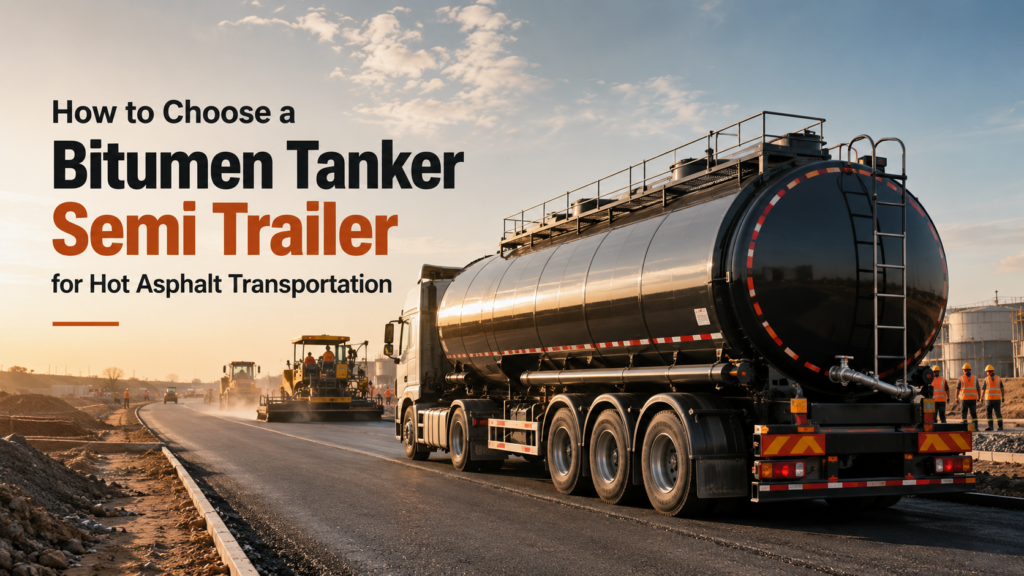
A bitumen tanker semi trailer is a special tank trailer designed for transporting hot liquid bitumen, asphalt, heavy oil, and other high-viscosity materials. It is commonly used in road construction, asphalt plant supply, highway maintenance, and infrastructure projects.
Unlike fuel tankers or water tank trailers, a bitumen tanker must keep the cargo at a suitable temperature during transport. For this reason, the tank body is usually equipped with an insulation layer, heating system, temperature control devices, and heat-preserved discharge pipelines. These features help keep the asphalt fluid and make loading and unloading safer and more efficient.
Why the Right Trailer Matters
In actual asphalt transportation, temperature control is one of the biggest challenges. If the trailer cannot maintain heat properly, the bitumen may cool down before reaching the construction site. This can lead to slow unloading, increased burner fuel consumption, pipeline blockage, and longer waiting time on site.
For short-distance delivery, a basic insulated asphalt tanker may be enough. But for long-distance transportation, cold-weather operation, or continuous road construction projects, the trailer must have stronger heat preservation and a more reliable heating system.
A well-designed bitumen tanker trailer can help reduce heat loss, shorten unloading time, lower fuel consumption, and improve transport efficiency. It also reduces the risk of breakdowns caused by poor pipeline design or weak chassis structure.
Choose the Right Tank Capacity
Tank capacity is usually the first thing buyers consider. Common bitumen tanker semi trailers are available in 30,000 liters, 35,000 liters, 40,000 liters, 45,000 liters, or customized capacity according to local regulations and project requirements.
However, larger capacity does not always mean better performance. The suitable capacity depends on transport distance, road conditions, legal payload limit, axle load requirements, tractor power, and job site access.
For long-distance transportation between asphalt plants, terminals, and construction areas, a larger tank can reduce the number of trips and improve daily delivery volume. For city road construction, mountain roads, or narrow job sites, a medium-capacity tanker may be easier to operate and safer to use.
Before confirming the tank volume, buyers should calculate the total vehicle weight, actual payload, axle distribution, and whether the trailer can legally run on local roads when fully loaded.
Check the Tank Material and Structure
The tank body is the main working part of the bitumen tanker semi trailer. It must withstand high temperature, liquid impact, vibration, and long-term road stress. For most hot asphalt transport applications, carbon steel is widely used because it offers good strength, stable welding performance, and reasonable cost.
Some customers may choose stainless steel when the cargo requires better corrosion resistance. But for standard bitumen and hot asphalt transportation, a well-manufactured carbon steel tank is usually a practical choice.
A reliable tank structure should include proper tank thickness, strong supports, smooth welding, reinforced connection points, and internal baffles. Internal baffles are important because they reduce liquid movement during braking, turning, and driving on uneven roads. This improves driving stability and helps protect the tank body.
When comparing different trailers, buyers should not only look at the tank size. Welding quality, reinforcement design, and overall structural strength are also important indicators of trailer quality.
Pay Attention to Insulation Performance
Insulation directly affects temperature retention. For hot asphalt transportation, good insulation is often more important than many buyers realize. If the insulation layer is poor, the bitumen temperature will drop quickly during transport, especially in cold weather or long-distance delivery.
Common insulation materials include rock wool, glass wool, polyurethane, or other thermal insulation materials. The insulation layer is usually covered with stainless steel plate, aluminum plate, or painted steel sheet to protect it from rain, wind, dust, and external damage.
Good insulation can help the trailer maintain asphalt temperature for a longer time, reduce reheating before unloading, save fuel, and improve working efficiency. For long-distance transport, buyers should ask the manufacturer about the expected temperature loss within a certain number of hours, instead of only asking about insulation thickness.
The quality of insulation is not only decided by the material itself. Installation workmanship, sealing treatment, outer cladding quality, and tank structure also affect the final heat preservation result.
Select a Suitable Heating System
Because bitumen becomes thicker when it cools, many bitumen tanker trailers need a heating system. The heating system can keep the asphalt warm during transport or reheat the material before unloading.
There are several common heating methods.
Diesel Burner Heating
Diesel burner heating is widely used because it is independent, practical, and suitable for many working environments. It is especially useful for long-distance transportation and construction sites where external heating equipment is not available.
When choosing diesel burner heating, buyers should check the burner brand, heating efficiency, fuel consumption, ignition safety, and maintenance convenience. A good burner system should heat efficiently and operate safely under high-temperature working conditions.
Thermal Oil Heating
Thermal oil heating provides more uniform heat transfer. It is suitable for professional asphalt transportation, long-distance delivery, and projects that require more stable temperature control.
Compared with direct heating, thermal oil heating can reduce the risk of local overheating and help maintain the quality of the asphalt. It is usually a better choice for customers who frequently transport hot bitumen and need higher operating stability.
Exhaust Heating
Some trailers use the tractor’s exhaust heat as an auxiliary heating method. This can help reduce fuel consumption, but it may not be powerful enough for all working conditions. It is usually more suitable as supplementary heating rather than the main heating method.
The right heating system should be selected according to transport distance, climate, unloading frequency, fuel availability, and the customer’s actual operating environment.
Do Not Ignore the Discharge System
The discharge system is one of the most easily overlooked parts of a bitumen tanker semi trailer. In many cases, unloading problems are not caused by the tank body but by the pipeline.
Bitumen can cool quickly inside the discharge pipe. If the pipe has no insulation or heating protection, the material may become thick and block the pipeline. This will increase unloading time and may require additional heating or cleaning work.
A practical discharge system should have a reasonable pipe diameter, high-temperature resistant valves, good sealing performance, and simple maintenance access. For some applications, the discharge pipeline should also have insulation or heating protection.
If fast unloading is required, an asphalt pump can be added. Pump discharge is especially useful for construction sites where gravity discharge is not convenient or where unloading efficiency is important.
Before purchase, buyers should confirm the outlet position, pipe layout, valve type, pump option, and cleaning method. A well-designed discharge system can save a lot of time during daily operation.
Choose a Strong Chassis and Reliable Running Gear
A bitumen tanker semi trailer carries high-density liquid cargo and often works under heavy-duty conditions. Therefore, the chassis must be strong enough to support the tank body and maintain stability on different roads.
A typical bitumen tanker trailer may use two axles, three axles, or customized axle configurations. In many markets, a 3 axle bitumen tanker semi trailer is a common choice because it offers good payload capacity and stable road performance.
Suspension can be mechanical suspension or air suspension. Mechanical suspension is strong, simple, and suitable for rough roads or construction sites. Air suspension provides smoother driving, better shock absorption, and improved stability on highways.
Other important components include axles, tires, landing gear, kingpin, braking system, ABS, lights, and electrical system. These parts directly affect safety, durability, and maintenance cost.
A strong tank with a weak chassis is not a good trailer. The whole vehicle should be designed as one complete transport system.
Safety Features Are Essential
Hot bitumen transportation involves high temperature, heavy cargo, and complex operating conditions. Safety should always be considered when choosing a tanker trailer.
Important safety configurations include anti-slip walkways, safety handrails, temperature gauges, pressure relief devices, emergency shut-off valves, fire extinguisher brackets, reflective markings, grounding systems, and reliable manhole covers.
The heating system also needs proper protection. If the trailer uses a diesel burner, the burner area should be easy to inspect and should have safe ignition and flame protection design.
Operators often need to climb onto the tank for inspection or loading work. Therefore, the walkway, ladder, and handrail design should be safe and practical. A small design detail can make a big difference in daily operation.
Consider Local Road Regulations
Different countries and regions have different requirements for semi trailers. Before purchasing a bitumen tanker semi trailer, buyers should confirm local regulations for total vehicle length, width, height, axle load, gross weight, braking system, lighting, side protection, rear bumper, reflective tape, and tanker safety standards.
For export markets, customization is often necessary. The trailer may need different axle brands, suspension types, tire models, kingpin sizes, electrical systems, or painting standards according to the target country.
Buyers should provide tractor specifications, road conditions, payload requirements, and local legal limits to the manufacturer before production. This helps ensure that the trailer can operate legally and safely after delivery.
Think About Long-Term Operating Cost
The purchase price is important, but it should not be the only standard. For hot asphalt transportation, operating cost is closely related to insulation quality, heating efficiency, unloading speed, maintenance frequency, and service life.
A cheaper trailer may have lower initial cost, but it may also bring higher fuel consumption, more heat loss, slower unloading, frequent valve problems, or shorter service life. In the long run, these problems can cost more than the initial savings.
When evaluating a trailer, buyers should consider total operating cost, including fuel use, maintenance, spare parts, downtime, tire wear, and repair convenience.
A reliable bitumen tanker semi trailer may cost more at the beginning, but it can provide better performance and lower cost over years of operation.
Work with an Experienced Manufacturer
A bitumen tanker semi trailer is not a simple tank mounted on a frame. It requires experience in tank design, heating layout, insulation installation, welding process, chassis matching, and safety configuration.
An experienced manufacturer should be able to recommend suitable solutions according to the buyer’s transport distance, climate, road conditions, loading capacity, and local regulations.
Before placing an order, buyers can ask about the following details:
- Tank volume and effective loading capacity
- Tank material and thickness
- Insulation material and structure
- Heating method
- Burner or thermal oil system configuration
- Discharge pipeline design
- Valve specifications
- Axle and suspension brand
- Brake system
- Tire model
- Painting and anti-corrosion treatment
- Spare parts and after-sales support
A professional supplier should not only provide a quotation, but also explain why each configuration is suitable for the customer’s working conditions.
Common Mistakes to Avoid
Some buyers focus only on price and tank volume when purchasing a bitumen tanker trailer. This can lead to problems after delivery.
One common mistake is choosing the largest tank without checking local axle load limits. If the trailer cannot legally carry the full load, the extra capacity becomes useless.
Another mistake is ignoring insulation quality. Poor insulation may not be obvious at first glance, but it will affect every trip.
Some buyers also overlook the discharge pipeline. Even when the tank keeps the asphalt hot, the pipe may cool down faster and cause blockage.
Choosing an unsuitable heating system is another problem. A heating system that works well for short-distance delivery may not be enough for long-distance transportation or cold weather operation.
To avoid these problems, buyers should evaluate the trailer based on actual working conditions instead of only comparing basic specifications.
Frequently Asked Questions
What is a bitumen tanker semi trailer used for?
A bitumen tanker semi trailer is mainly used to transport hot liquid bitumen, asphalt, heavy oil, and other high-viscosity materials. It is commonly used for road construction, asphalt plant supply, highway maintenance, and infrastructure projects.
What capacity should I choose for a bitumen tanker semi trailer?
Common capacities include 30,000 liters, 35,000 liters, 40,000 liters, and 45,000 liters. The right capacity depends on the transport distance, local axle load limits, road conditions, tractor power, and job site access. A larger tank can improve delivery efficiency, but it must comply with local weight regulations.
Why does a bitumen tanker trailer need insulation?
Bitumen must remain hot and fluid during transportation. The insulation layer helps reduce temperature loss, keep the asphalt easier to discharge, reduce reheating time, and lower fuel consumption. For long-distance transport or cold-weather operation, good insulation is especially important.
What heating system is commonly used on a bitumen tanker trailer?
Diesel burner heating and thermal oil heating are commonly used. Diesel burner heating is practical and suitable for many transport conditions, while thermal oil heating provides more uniform heat transfer and better temperature control for long-distance or professional asphalt transportation.
Is diesel burner heating enough for hot asphalt transportation?
Diesel burner heating is suitable for many hot asphalt transport applications, especially when the trailer needs an independent heating source. However, for long-distance transport, cold regions, or higher temperature control requirements, thermal oil heating may be a better option.
How can I prevent bitumen from blocking the discharge pipeline?
To reduce the risk of blockage, the discharge pipeline should have proper insulation or heating protection. High-temperature resistant valves, a reasonable pipe diameter, and a simple pipeline layout also help improve unloading efficiency. For some projects, an asphalt pump can be added to support faster discharge.
What is the difference between a bitumen tanker trailer and a fuel tanker trailer?
A fuel tanker trailer is mainly designed for low-viscosity liquid fuels such as diesel or gasoline. A bitumen tanker trailer is designed for high-temperature and high-viscosity materials. It usually has insulation, heating equipment, heat-preserved pipelines, and special valves suitable for hot asphalt transportation.
Is a 3 axle bitumen tanker semi trailer suitable for road construction projects?
Yes. A 3 axle bitumen tanker semi trailer is widely used in road construction and asphalt supply because it offers good payload capacity, stable driving performance, and compatibility with many market regulations. The final axle configuration should still be selected according to local road laws and loading requirements.
Can a bitumen tanker semi trailer be customized?
Yes. The tank capacity, tank material, insulation layer, heating system, discharge method, axle brand, suspension type, tire model, braking system, and painting can all be customized according to the buyer’s working conditions and local regulations.
What should I check before buying a bitumen tanker semi trailer?
Before purchasing, check the tank capacity, tank material, insulation performance, heating system, discharge pipeline, valve quality, chassis strength, axle and suspension configuration, braking system, safety devices, and after-sales support. It is also important to confirm whether the trailer design meets local transport regulations.