
If you’re planning to invest in a car carrier truck, one of the first decisions you’ll face is whether to choose an open carrier or an enclosed carrier. Both are designed to transport vehicles, but they serve different purposes and suit different types of customers.
The right choice depends on several factors, including the vehicles you transport, your operating budget, customer expectations, and the type of transport services you provide.
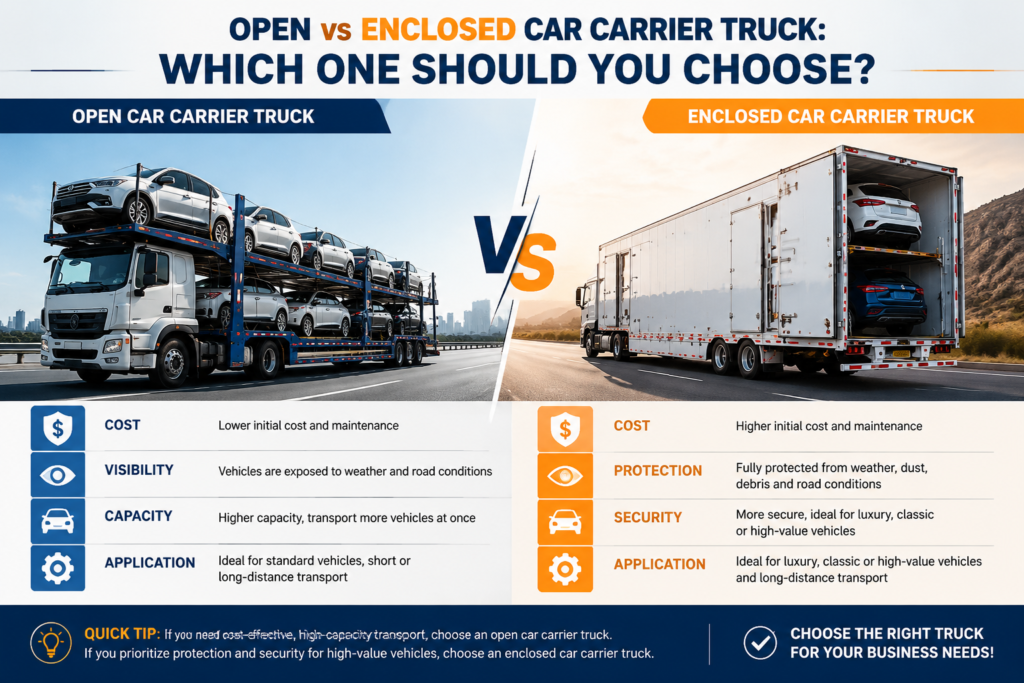
Open car carriers are the most common option in the vehicle logistics industry. They are cost-effective, easy to operate, and ideal for transporting standard passenger vehicles. Enclosed car carriers, on the other hand, offer a higher level of protection and are often used for luxury, classic, exotic, or high-value vehicles.
In this article, we’ll compare open and enclosed car carrier trucks in terms of cost, capacity, protection, maintenance, and practical applications to help you determine which option best fits your business.
If you are still comparing different vehicle transport solutions, you can also read our complete car carrier truck buying guide to understand truck types, loading capacity, key specifications, price factors, and buying tips before requesting a quotation.
What Is an Open Car Carrier Truck?
An open car carrier truck transports vehicles on an exposed platform without a fully enclosed body. Vehicles are secured using wheel straps, chains, or other tie-down systems and remain visible throughout transportation.
This type of carrier is widely used by:
- Vehicle logistics companies
- Car dealerships
- Used car exporters
- Fleet operators
- Rental car companies
Open carriers can be configured to transport a single vehicle or multiple vehicles at the same time. Many models feature hydraulic ramps and adjustable decks to simplify loading and unloading.
Because of their simpler structure, open carriers generally offer greater payload capacity and lower operating costs than enclosed models.
What Is an Enclosed Car Carrier Truck?
An enclosed car carrier truck transports vehicles inside a covered structure that shields them from external elements during transit.
These carriers are commonly used for:
- Luxury vehicles
- Classic cars
- Sports cars
- Racing vehicles
- Collector vehicles
- High-value electric vehicles
Enclosed carriers may be built as rigid trucks or semi-trailers and often include additional features such as hydraulic lift gates, air suspension systems, interior lighting, and advanced securing equipment.
Their primary advantage is protection. Vehicles remain shielded from weather, dust, road debris, and public visibility throughout the journey.
Open vs Enclosed Car Carrier Truck: Main Differences
Although both serve the same basic purpose, there are significant differences between the two designs.
| Comparison Item | Open Car Carrier Truck | Enclosed Car Carrier Truck |
|---|---|---|
| Vehicle Protection | Basic | Excellent |
| Purchase Cost | Lower | Higher |
| Loading Capacity | Higher | Lower |
| Maintenance | Simpler | More Complex |
| Fuel Efficiency | Better | Lower |
| Loading Speed | Faster | Slower |
| Best Use | Standard vehicle transport | Premium vehicle transport |
| Weather Protection | Limited | Full Protection |
| Security & Privacy | Moderate | High |
| Business Positioning | Cost-efficient service | Premium service |
Advantages of Open Car Carrier Trucks
1. Lower Initial Investment
Open carriers are generally less expensive to purchase because they require fewer materials and have a simpler structure. There is no enclosed body, roof system, or specialized access equipment, which helps keep manufacturing costs down.
For businesses looking to expand their fleet without a large upfront investment, open carriers are often the preferred choice.
2. Greater Vehicle Capacity
Because they are lighter and more space-efficient, open carriers can usually transport more vehicles than enclosed carriers of similar dimensions.
Higher capacity often translates into lower transportation costs per vehicle, making open carriers attractive for large-scale logistics operations.
3. Faster Loading and Unloading
Drivers can easily access vehicles from multiple angles, making loading and unloading more efficient.
Many open carriers are equipped with hydraulic ramps and adjustable decks that further reduce loading time, especially when handling multiple vehicles each day.
4. Lower Maintenance Requirements
With fewer moving parts and body components, maintenance is generally simpler and less expensive.
There are no large doors, roof panels, ventilation systems, or enclosed-body components that require regular servicing.
5. Ideal for Everyday Vehicle Transport
Most vehicles transported by dealerships, auctions, rental companies, and logistics providers do not require special protection.
For standard sedans, SUVs, pickups, and fleet vehicles, open carriers provide a practical and economical solution.
Disadvantages of Open Car Carrier Trucks
1. Exposure to Weather
Vehicles remain exposed to rain, dust, sunlight, snow, and other environmental conditions during transport.
While this is acceptable for most standard vehicles, it may not be suitable for premium or collector cars.
2. Risk from Road Debris
Small stones, dirt, insects, and other road debris can come into contact with transported vehicles.
Although serious damage is uncommon, the risk is higher compared with enclosed transportation.
3. Limited Privacy
Vehicles are visible throughout the journey.
For owners of luxury or rare vehicles, this lack of privacy may be a concern.
Advantages of Enclosed Car Carrier Trucks
1. Maximum Vehicle Protection
The biggest advantage of an enclosed carrier is the level of protection it provides.
Vehicles remain protected from:
- Rain
- Dust
- UV exposure
- Road debris
- Harsh weather conditions
This makes enclosed carriers the preferred choice for transporting valuable vehicles.
2. Improved Security
Because vehicles are hidden from public view, enclosed carriers offer an additional layer of security.
This can be particularly important when transporting luxury vehicles, collector cars, or limited-production models.
3. Premium Customer Experience
Customers paying for high-end transport services often expect the highest level of care.
Using an enclosed carrier can enhance your company’s professional image and help justify premium pricing.
4. Better for Specialty Vehicles
Certain vehicles require extra protection during transport.
Examples include:
- Classic cars
- Exotic sports cars
- Race cars
- Show vehicles
- Luxury EVs
Many enclosed carriers can be customized with low-angle ramps, soft tie-down systems, air suspension, and hydraulic lift platforms to accommodate these vehicles safely.
Disadvantages of Enclosed Car Carrier Trucks
1. Higher Purchase Price
Enclosed carriers require additional structural components, specialized equipment, and more complex manufacturing processes.
As a result, they typically cost significantly more than open carriers.
2. Reduced Capacity
The enclosed structure limits available loading space and increases vehicle weight.
This often results in fewer vehicles being transported per trip.
3. More Maintenance
Additional components such as doors, seals, lighting systems, ventilation equipment, and hydraulic mechanisms require ongoing maintenance.
Over time, maintenance costs can be noticeably higher.
4. Higher Operating Costs
Enclosed carriers are generally heavier and may consume more fuel.
Combined with lower vehicle capacity, operating costs per transported vehicle are often higher.
Which One Is Better for Your Business?
There is no universal answer because every transport business operates differently.
An open car carrier truck is usually the better choice if you:
- Transport standard passenger vehicles
- Handle dealership deliveries
- Move auction vehicles
- Focus on high-volume logistics
- Prioritize operating efficiency
An enclosed car carrier truck may be the better option if you:
- Transport luxury vehicles
- Handle classic or collector cars
- Serve premium customers
- Offer specialized transport services
- Need maximum protection and privacy
In short, open carriers focus on efficiency and volume, while enclosed carriers focus on protection and premium service.
Best Applications for Open Car Carrier Trucks
Open carriers are commonly used for:
- New vehicle distribution
- Used car transportation
- Auction vehicle delivery
- Fleet relocation
- Rental vehicle transfers
- Regional logistics operations
- Dealer-to-dealer transport
- Port transportation
For most commercial transport companies, open carriers remain the backbone of daily operations.
Best Applications for Enclosed Car Carrier Trucks
Enclosed carriers are commonly used for:
- Luxury vehicle transport
- Classic car transportation
- Motorsport logistics
- Collector vehicle delivery
- Vehicle exhibitions
- High-end dealership services
- Premium EV transportation
- Show car transport
Businesses targeting high-value customers often rely on enclosed carriers to maintain service quality and vehicle condition.
Cost Comparison: Open vs Enclosed Car Carrier Truck
Cost should be evaluated from both a purchase and operational perspective.
Open carriers generally offer:
- Lower purchase prices
- Lower maintenance costs
- Better fuel efficiency
- Higher vehicle capacity
Enclosed carriers typically provide:
- Better vehicle protection
- Higher service value
- Premium pricing opportunities
- Greater customer confidence
The most profitable option depends on your customer base and business model rather than simply the purchase price.
Key Specifications to Check Before Buying
Regardless of which type you choose, several technical factors deserve careful attention.
1. Loading Capacity
Capacity depends on more than the number of vehicles.
Consider:
- Vehicle dimensions
- Vehicle weight
- Deck length
- Axle ratings
- Local transport regulations
2. Ramp Design
Ramp angle affects loading safety.
Low-clearance vehicles such as sports cars and luxury vehicles require carefully designed ramps to avoid damage during loading.
3. Hydraulic System
A reliable hydraulic system improves efficiency and safety.
Inspect the quality of:
- Hydraulic cylinders
- Pumps
- Valves
- Control systems
- Safety locks
4. Vehicle Securing System
A quality carrier should include:
- Strong tie-down points
- Wheel straps
- Safety chains
- Wheel chocks
- Anti-slip surfaces
Proper securing equipment is essential for safe transportation.
5. Chassis and Frame Strength
The chassis is the foundation of the carrier.
Look for:
- Reinforced frame construction
- Quality welding
- Corrosion protection
- Durable structural design
6. Suspension and Braking Systems
Reliable suspension and braking systems improve safety and vehicle protection.
Air suspension is often preferred for premium vehicle transport, while mechanical suspension remains popular for heavy-duty operations.
7. Compliance with Local Regulations
Before purchasing, verify local requirements regarding:
- Vehicle dimensions
- Gross vehicle weight
- Axle loads
- Lighting standards
- Transport permits
Compliance issues can create costly operational problems later.
Open or Enclosed: Quick Buying Guide
Choose an open car carrier truck if:
- You transport standard vehicles.
- You operate a dealership fleet.
- You export used vehicles.
- You focus on high-volume logistics.
- Budget and efficiency are priorities.
Choose an enclosed car carrier truck if:
- You transport luxury vehicles.
- You handle collector or classic cars.
- Your customers expect premium service.
- Vehicle protection is critical.
- Privacy and security are important.
FAQ About Open and Enclosed Car Carrier Trucks
Is an enclosed car carrier truck always the better option?
Not necessarily. While enclosed carriers provide superior protection, open carriers are often more practical and economical for standard vehicle transportation.
Are open car carrier trucks safe?
Yes. When vehicles are properly secured and the carrier is operated correctly, open carriers provide safe and reliable transportation for most vehicle types.
Why do enclosed carriers cost more?
The enclosed structure, additional equipment, specialized loading systems, and higher manufacturing complexity all contribute to the increased cost.
Which carrier is best for luxury vehicles?
Enclosed car carriers are generally the preferred choice because they provide maximum protection and privacy.
Are open carriers suitable for SUVs and pickups?
Yes. However, larger vehicles occupy more space and may reduce the total number of vehicles that can be transported on a single trip.
Which option should I buy?
If your business focuses on standard vehicle logistics, an open carrier is usually the most cost-effective solution. If you specialize in transporting high-value vehicles, an enclosed carrier is often worth the additional investment.
Conclusion
Both open and enclosed car carrier trucks play important roles in the vehicle transportation industry.
Open carriers remain the preferred choice for dealerships, logistics companies, fleet operators, and used car exporters because they offer excellent efficiency, higher capacity, and lower operating costs.
Enclosed carriers are designed for situations where vehicle protection, privacy, and premium service matter most. Although they require a larger investment, they provide added value for businesses serving luxury and specialty vehicle markets.
Before making a purchase decision, evaluate your typical cargo, customer expectations, operating routes, and long-term business goals. The right carrier should not only fit your current needs but also support future growth and profitability.