
Steel coils may look like straightforward cargo, but they place unusually high demands on a trailer.
The main issue is not simply their weight. A steel coil concentrates a large amount of weight within a relatively small area of the deck. That load must pass through the deck plate, cross members, main beams, suspension, axles, tires, and finally the road.
A standard flatbed Semi trailer may have enough total payload on paper, yet still be unsuitable for carrying heavy coils repeatedly. If the loading area is not properly reinforced, the result may be deck deformation, cracked welds, damaged cross members, uneven tire wear, or overloaded axles.
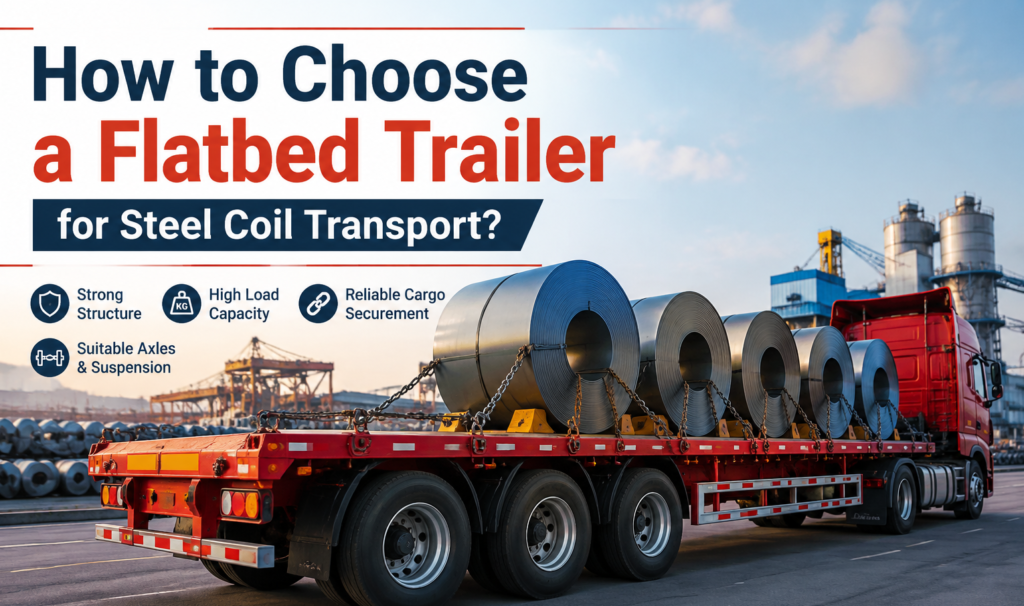
For this reason, selecting a flatbed trailer for steel coil transport should begin with the cargo itself. Coil weight, dimensions, loading direction, transport distance, road quality, local axle regulations, and unloading methods all affect the final trailer specification.
Why Steel Coils Require a Different Trailer Design
Most general freight spreads its weight across a large part of the trailer deck. Steel coils do not.
A single coil may weigh 15, 20, or even 30 tons while occupying only a short section of the platform. This creates a concentrated load rather than an evenly distributed load.
The round shape introduces another problem. Without suitable supports and securement, a coil can roll or shift during braking, cornering, or emergency maneuvers. Even a small movement can place severe force on the trailer and create a serious safety risk.
Steel coils are normally loaded in one of three directions:
- Eye to the sky
- Eye facing sideways
- Eye facing forward or backward
The safest supporting method depends on the loading direction. A trailer designed for an eye-to-the-sky coil may require a different deck arrangement from one carrying coils with the eye facing sideways.
Before discussing axles, suspension, or price, confirm how the coils will actually be loaded.
Begin With the Real Cargo Information
A trailer manufacturer cannot recommend the correct structure based only on a requested payload such as “40 tons.”
The quotation should be based on the actual coil specifications.
Provide the following information:
| Information | Why it is needed |
|---|---|
| Maximum weight of one coil | Determines concentrated load requirements |
| Average coil weight | Helps evaluate normal operating conditions |
| Number of coils per trip | Affects positioning and total payload |
| Coil outside diameter | Determines cradle or coil well dimensions |
| Coil width | Affects contact area and loading position |
| Loading direction | Determines the support and securement arrangement |
| Maximum total cargo weight | Helps select axles, suspension, tires, and brakes |
| Loading method | Confirms whether cranes, forklifts, or other equipment will be used |
| Destination country | Allows the trailer to be matched to local regulations |
| Road conditions | Influences chassis and suspension design |
Always design around the heaviest coil expected in normal operation, not only the average load.
If most coils weigh 18 tons but the company regularly transports 25-ton coils, the trailer must be built around the 25-ton requirement.
Total Payload Is Only Part of the Calculation
One of the most common purchasing mistakes is to compare trailers only by advertised payload.
A 50-ton flatbed trailer is not automatically suitable for placing a 25-ton coil in the middle of the deck. The total carrying capacity and the concentrated load capacity are two different things.
The correct questions are:
- How much total cargo can the trailer carry?
- How much weight can be placed in the coil-loading area?
- Where should the coil be positioned?
- How will the load be distributed to the tractor and trailer axles?
For repeated steel coil transport, the loading area may require closer cross-member spacing, additional longitudinal supports, thicker deck material, or reinforced connections between the cross members and main beams.
Simply making the entire trailer heavier is not always the best solution. A good design adds strength where the load is actually applied.
Should the Trailer Have a Coil Well?
A coil well is a recessed section in the trailer deck used to hold and support a steel coil.
It is common on trailers that carry coils regularly because it helps keep the cargo in a consistent position and reduces the possibility of rolling.
A typical coil well may include:
- Sloped supporting surfaces
- Reinforced internal framing
- Removable deck covers
- Timber or rubber contact materials
- Chain access points
- Removable supports or chocks
When the well is covered, the trailer can often be used for steel plates, machinery, building materials, or other general cargo.
When a Coil Well Makes Sense
A built-in coil well is worth considering when:
- Steel coils are transported frequently
- Coil dimensions are relatively consistent
- Faster loading and positioning are important
- The trailer is mainly used for steel products
- The operator wants a dedicated and repeatable loading method
When Removable Cradles May Be Better
A permanent coil well is not necessary for every operation.
Removable cradles may be more practical when:
- Coils are transported only occasionally
- The trailer also carries containers
- A completely flat deck is needed for return loads
- Coil sizes vary significantly
- The loading site already uses its own approved support system
For mixed freight operations, a multipurpose flatbed with removable coil supports often provides better vehicle utilization.
For daily coil transport, a dedicated steel coil trailer is usually easier to operate.
Pay Close Attention to the Main Beams
The main beams carry the load through the length of the trailer. Their performance depends on more than steel thickness.
Beam height, flange dimensions, web thickness, reinforcement location, welding quality, and material grade all influence structural strength.
A well-designed steel coil trailer should resist:
- Vertical bending
- Repeated fatigue loading
- Twisting on uneven roads
- Local stress around the coil position
- Deformation near suspension mounting points
High-strength steel is often used to improve resistance to bending while keeping the trailer’s own weight under control. However, the steel grade alone does not guarantee quality.
Poor welding, incorrect reinforcement, or badly positioned cross members can weaken a trailer made from good material.
Buyers should ask how the chassis has been modified for coil transport. A useful answer should describe the reinforced loading zone, beam structure, cross-member arrangement, and expected load path.
A vague answer such as “we use a heavy-duty beam” does not provide enough information.
Deck Plate and Cross Members Matter
The deck is the first part of the trailer to receive the coil load.
If the deck plate is too thin or the cross members are spaced too far apart, the loading area may bend even when the main beams remain intact.
For steel coil transport, review:
- Deck plate thickness
- Cross-member dimensions
- Cross-member spacing
- Reinforcement under the coil position
- Welding between the deck, cross members, and main frame
- Surface treatment
- Drainage
- Anti-slip measures
The most heavily loaded section may need a different structure from the rest of the trailer.
This is often more effective than increasing the thickness of every component, which adds unnecessary tare weight and may reduce legal payload.
Axle Configuration Must Match the Load Position
Three-axle flatbed trailers are common in many export markets, but that does not mean three axles are correct for every steel coil operation.
Axle selection depends on:
- Maximum cargo weight
- Number of coils
- Coil position
- Tractor axle configuration
- Fifth-wheel position
- Local axle-load limits
- Road quality
- Required turning radius
- Tire and maintenance costs
A heavy coil placed too far forward can overload the tractor’s drive axles or fifth wheel.
The same coil placed too far backward can overload the trailer axle group and reduce weight on the tractor, affecting traction and handling.
The manufacturer should calculate the expected load distribution using the actual tractor and trailer dimensions.
This is especially important when one very heavy coil is carried instead of several smaller coils.
Adding another axle may increase legal load capacity in some markets, but it also means more tires, more brakes, greater maintenance cost, and a larger turning radius. The additional axle should solve a real load-distribution problem, not simply make the specification appear stronger.
Mechanical Suspension or Air Suspension?
Both systems can work, but the choice should reflect the operating environment.
Mechanical Suspension
Mechanical suspension remains a practical choice for rough roads, industrial areas, construction routes, and markets where simple maintenance is important.
It is generally preferred for:
- Poor or unpaved roads
- Heavy-duty transport
- Remote operating areas
- Fleets with limited access to specialized repair services
- Markets where mechanical suspension parts are easier to obtain
The system is relatively simple, durable, and familiar to many workshops.
If you are still comparing different flatbed trailer configurations rather than selecting a dedicated coil trailer, our complete flatbed semi trailer buying guide explains how suspension affects different transport applications.
Air Suspension
Air suspension is more common in highway operations where ride quality, stability, and reduced vibration are priorities.
It may be suitable for:
- Long-distance paved-road transport
- Fleets with reliable maintenance support
- Operations requiring ride-height adjustment
- Applications where axle lifting is useful
- Routes where smoother vehicle behavior is important
Air suspension does not make an unsuitable chassis safe, and it does not replace proper coil supports or cargo securement.
For difficult roads, a strong mechanical suspension is often the more practical choice. For controlled highway work, air suspension can offer better ride quality.
Cargo Securement Must Be Designed Into the Trailer
Securement should not be treated as an accessory added after production.
Steel coils generate significant force during braking and cornering. The trailer should include anchor points in the correct positions so that chains or other approved devices can restrain the cargo in every direction.
Common equipment includes:
- Heavy-duty lashing rings
- Recessed anchor points
- Chain hooks
- Coil chocks
- Removable cradles
- Timber supports
- Rubber friction mats
- Load binders
- Edge protection
- Front bulkheads
Anchor points should be connected to structural members. Welding a lashing ring only to a thin deck plate may create a weak point.
The working load limit of the anchor points should also match the chains, binders, and other equipment used by the operator.
A front headboard may provide additional protection, but it should never be considered a replacement for proper restraint.
Cargo securement rules vary between countries. Trailer buyers should confirm local requirements before finalizing the design, especially when the trailer will be used for cross-border transport.
Brakes, Tires, Hubs, and Bearings
A trailer built for heavy coils needs a running system that matches its gross operating weight.
Braking System
Brake specifications should be selected according to:
- Gross trailer weight
- Axle quantity
- Operating speed
- Road gradient
- Tractor compatibility
- Destination market regulations
Depending on the country, ABS or EBS may be required. Brake chamber size, drum or disc configuration, and air connections should also match the intended operation.
Tires
Tires must have sufficient load and speed ratings.
Buyers should also consider whether the selected tire size and brand can be replaced easily in the local market.
A low-cost tire that is difficult to source may cause more downtime than a slightly more expensive but commonly available alternative.
For long-distance work, heat resistance and consistent tire quality are particularly important.
Hubs and Bearings
Hubs, rims, and bearings should be matched to the axle rating. Reliable components and accessible spare parts usually provide better long-term value than selecting unfamiliar parts based only on price.
Road Conditions Change the Specification
A trailer operating between a steel mill and a nearby port has different requirements from one traveling hundreds of kilometers on rough regional roads.
Poor roads create repeated shock loading. Over time, this can lead to:
- Cracked welds
- Suspension wear
- Loose fasteners
- Tire damage
- Bearing problems
- Chassis fatigue
- Movement of the cargo securement system
For rough-road applications, useful upgrades may include:
- Reinforced chassis sections
- Heavy-duty mechanical suspension
- Stronger landing gear
- Increased ground clearance
- Protected air and electrical lines
- Durable brake components
- Additional anti-corrosion treatment
For highway operations, lower tare weight, stable braking, tire quality, fuel efficiency, and axle alignment may be more important.
The manufacturer should know where the trailer will operate before recommending a standard specification.
Dedicated Steel Coil Trailer or Multipurpose Flatbed?
A dedicated steel coil trailer is usually built around one main job.
It may have a fixed coil well, permanent reinforcement, specialized anchor points, and a loading layout designed for repeated coil transport.
This type of trailer is suitable for steel mills, metal distributors, and logistics companies that transport coils every day.
A multipurpose flatbed offers more flexibility. With removable coil supports and optional container twist locks, it may also carry:
- Shipping containers
- Steel plates
- Pipes
- Structural beams
- Machinery
- Building materials
- General industrial cargo
The right choice depends on the availability of return loads.
A dedicated trailer may be more efficient for outbound coil deliveries, but a multipurpose design may be more profitable when the vehicle needs to carry different cargo on the return journey.
Before ordering, consider how the trailer will be used over an entire month rather than focusing on only one trip.
How to Assess Manufacturing Quality
Photos alone are not enough to judge a steel coil trailer.
Two trailers may look almost identical when new, but their performance after several years can be very different.
Review the manufacturer’s production process, including:
- Steel cutting accuracy
- Main beam assembly
- Welding procedures
- Cross-member installation
- Axle alignment
- Surface preparation
- Shot blasting
- Primer application
- Topcoat quality
- Brake testing
- Electrical testing
- Final inspection
Axle alignment is particularly important. Poor alignment increases tire wear and can affect handling.
Surface preparation also matters. Paint applied over rust, oil, or welding residue may look acceptable at delivery but begin peeling soon after the trailer enters service.
Where possible, request technical drawings, material information, production photographs, component brands, and inspection records.
Information to Include in a Quotation Request
A clear inquiry usually produces a more accurate quotation.
Send the manufacturer:
| Item | Details |
| Maximum coil weight | Weight of the heaviest single coil |
| Normal coil weight | Typical weight during daily operation |
| Coil dimensions | Outside diameter, inside diameter, and width |
| Coil quantity | Number carried per trip |
| Loading direction | Eye up, eye sideways, or eye lengthwise |
| Total payload | Maximum cargo weight |
| Tractor details | Axle configuration and fifth-wheel height |
| Road conditions | Highway, rural road, industrial road, or mixed |
| Destination country | Needed for legal and component requirements |
| Transport distance | Local, regional, or long-distance |
| Suspension | Mechanical or air suspension |
| Axles | Preferred quantity, capacity, and brand |
| Securement | Coil well, cradle, chains, chocks, and anchor points |
| Other cargo | Containers, steel plates, machinery, or general freight |
Avoid sending only a message such as “Please quote a 60-ton steel coil trailer.”
Without cargo dimensions, loading direction, road conditions, and local regulations, the supplier may quote a generic trailer that does not match the actual job.
Common Buying Mistakes
Looking Only at the Purchase Price
A lower quotation may use thinner materials, lighter axles, fewer reinforcements, or less reliable components.
The real cost becomes clear after the trailer begins working.
Confusing Payload With Point-Load Capacity
A trailer can have sufficient total payload but insufficient strength beneath the coil position.
Ignoring Coil Position
Incorrect positioning can overload the tractor, fifth wheel, or trailer axles.
Using a General-Purpose Deck Without Checking the Structure
A standard flatbed may need reinforcement before it can carry heavy coils regularly.
Installing Weak Anchor Points
Securement points must be connected to the trailer structure and rated for the intended loading method.
Choosing Components That Are Difficult to Replace
Uncommon axles, brake parts, or tire sizes can cause long periods of downtime.
Failing to Check Local Regulations
Gross weight, axle load, braking, dimensions, and cargo securement requirements differ between markets.
Steel Coil Trailer Checklist
Before confirming the order, check that:
- The maximum single-coil weight has been provided
- The loading direction has been confirmed
- Concentrated load capacity has been discussed
- The coil position has been calculated
- The deck and cross members are reinforced where necessary
- The main beam design is suitable for repeated coil transport
- The axle layout meets local load limits
- The suspension matches the road conditions
- Tires and rims have suitable load ratings
- The braking system meets local requirements
- Anchor points are properly positioned and structurally supported
- The coil well or cradle suits the actual coil dimensions
- Replacement parts are available locally
- Final inspection procedures have been agreed
Frequently Asked Questions
Can a normal flatbed trailer carry steel coils?
It may be possible, but only after confirming the trailer’s concentrated load capacity, deck structure, cross-member spacing, axle-load distribution, and securement system.
A standard flatbed should not be assumed suitable simply because its advertised payload is high enough.
Does every steel coil trailer need a coil well?
No. A coil well is useful for regular coil transport, while removable cradles may be better for a trailer that also carries containers or general cargo.
How many axles are needed?
There is no single answer. Axle quantity depends on cargo weight, coil position, tractor configuration, local axle regulations, and road conditions.
Three axles are common, but very heavy or specialized operations may require a different arrangement.
Which suspension is better for steel coil transport?
Mechanical suspension is often more practical on rough roads. Air suspension may provide better ride quality on paved highways.
The correct choice depends on route conditions and local maintenance capability.
Where should the coil be placed?
The position should be determined by load-distribution calculations. Placing the coil in the visual center of the deck does not guarantee correct axle loading.
Can the same trailer carry containers?
Yes. A multipurpose trailer can be fitted with twist locks and removable coil-support equipment, provided the two systems are designed to work together.
What should be sent to the manufacturer before ordering?
Provide the maximum coil weight, coil dimensions, loading direction, number of coils, destination country, road conditions, tractor configuration, required payload, and preferred securement method.
Final Thoughts
Choosing a flatbed trailer for steel coil transport is mainly an engineering and operating decision, not a price comparison.
The trailer must carry both the total cargo weight and the concentrated force created beneath each coil. Its deck, cross members, main beams, suspension, axles, tires, brakes, and securement points must work as one system.
For regular steel coil deliveries, a dedicated trailer with a reinforced loading area and coil well may offer the most efficient solution.
For companies carrying several types of cargo, a multipurpose flatbed with removable cradles and properly designed anchor points may provide better fleet flexibility.
A suitable specification begins with accurate cargo information. Send the manufacturer the maximum coil weight, dimensions, loading direction, road conditions, destination country, and tractor details before requesting a final quotation.
That information is far more useful than simply asking for the lowest price on a 40-ton or 60-ton flatbed trailer.