
Transporting liquids in bulk requires specialized equipment designed to handle unique physical and safety challenges. Unlike solid cargo, liquids shift during movement, respond to temperature changes, and may present risks such as flammability, corrosion, or contamination.
To address these challenges, the logistics industry relies on tank semi trailers, which are purpose-built for safely moving a wide range of liquid products—from fuel and chemicals to food and liquefied gases.
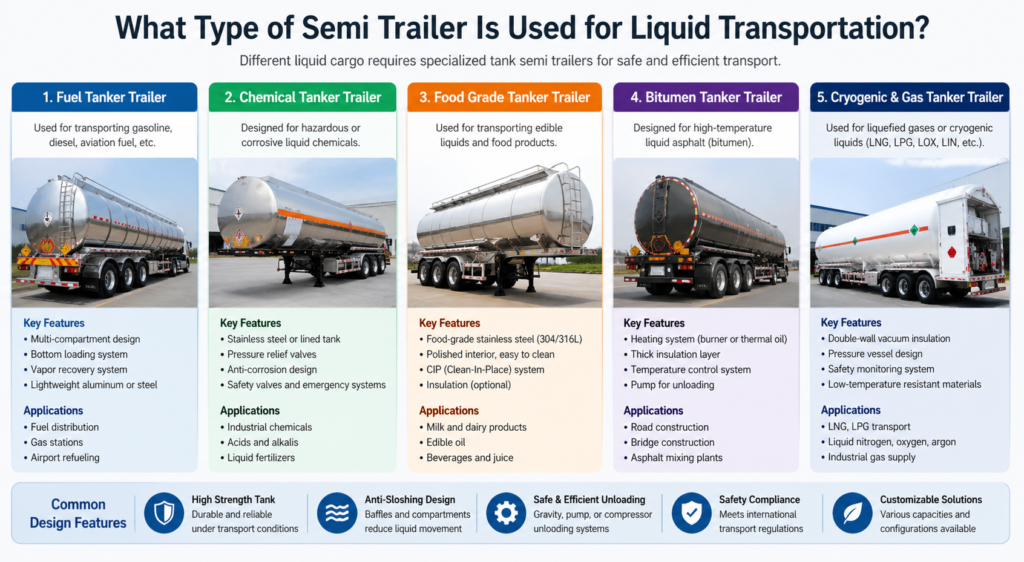
What Is a Tank Semi Trailer?
A tank semi trailer is a trailer equipped with a sealed tank mounted on a chassis. It is designed to transport liquids in bulk while maintaining stability and preventing leaks.
Key design considerations include:
- Managing liquid movement during transit
- Maintaining internal pressure and temperature
- Ensuring safe loading and unloading
To improve safety and performance, most tankers include internal partitions, reinforced structures, and specialized discharge systems.
Main Types of Liquid Transport Semi Trailers
1. Fuel Tanker Trailers
Fuel tankers are used to transport petroleum products such as gasoline, diesel, and aviation fuel. For buyers focused on gasoline delivery, this guide on how many gallons of gas a tanker truck holds explains typical fuel tanker capacity in gallons.
Features:
- Multiple compartments for different fuel types
- Lightweight construction to maximize payload
- Systems to control vapor emissions during loading and unloading
Applications:
Fuel distribution, gas stations, airport operations
2. Chemical Tanker Trailers
Chemical tankers are designed to carry substances that may be hazardous, corrosive, or reactive. For material selection, safety equipment, and daily operation details, read our guide on how to choose the right chemical tank trailer.
Features:
- Corrosion-resistant materials such as stainless steel or specialized linings
- Pressure control and safety valve systems
- Strict adherence to hazardous material transport regulations
Applications:
Industrial chemicals, fertilizers, solvents
3. Food-Grade Tanker Trailers
These tankers are used to transport consumable liquids such as milk, edible oil, and beverages. If your operation is dairy-focused, a dedicated milk transportation trailer guide can help with hygiene design, insulation, and capacity selection.
Features:
- Hygienic stainless steel construction
- Smooth interior surfaces for easy cleaning
- Systems designed to prevent contamination
Applications:
Dairy, food processing, beverage industries
4. Bitumen / Asphalt Tanker Trailers
Bitumen tankers are built to transport high-temperature materials used in road construction. For insulation, heating system, discharge pipeline, and capacity choices, see our bitumen tanker semi trailer buying guide.
Features:
- Heating systems to keep materials in liquid form
- Insulation to maintain temperature
- Pump systems for unloading
Applications:
Infrastructure and road construction projects
5. Cryogenic and Gas Tanker Trailers
These trailers are designed for transporting liquefied gases under extreme temperature or pressure conditions.
Features:
- Double-wall insulated tanks
- Pressure vessel design
- Advanced monitoring and safety systems
Applications:
Energy sector, medical gases, industrial gas supply
Key Design Features
Across all types, tank semi trailers share several important design elements:
- Tank shape: Often elliptical to improve stability
- Internal partitions: Reduce liquid movement during transport
- Loading and unloading systems: Designed for efficiency and safety
- Suspension systems: Improve handling and reduce rollover risk
How to Choose the Right Trailer
Selecting the appropriate trailer depends on liquid type, operating conditions, capacity needs, and regulatory requirements. When capacity is the main concern, check how tanker truck maximum capacity is affected by axle configuration, liquid density, and legal limits.
- Type of liquid: Determines material and design requirements
- Operating conditions: Temperature, distance, and environment
- Capacity needs: Balancing volume and maneuverability
- Regulatory requirements: Compliance with safety standards
Careful evaluation of these factors helps ensure safe and efficient operations.
FAQ
1. What type of semi trailer is used for transporting liquids?
Tank semi trailers are specifically designed for transporting liquids and are used across industries for fuel, chemicals, food products, and gases.
2. Why are special trailers needed for liquid transport?
Liquids move during transit and can create instability. Specialized trailers are designed to control this movement and ensure safety.
3. What materials are commonly used in tanker trailers?
Common materials include aluminum, carbon steel, and stainless steel, each selected based on the type of liquid being transported.
4. How is safety maintained during transport?
Safety is ensured through structural design, internal partitions, pressure control systems, and strict adherence to regulations.
5. Can one tanker carry different types of liquids?
Some tankers have multiple compartments, allowing them to carry different liquids, but compatibility and safety must always be considered.
6. What industries use liquid transport trailers?
Industries include energy, chemical manufacturing, food and beverage, construction, and healthcare.
Conclusion
Tank semi trailers are essential for modern liquid transportation, offering tailored solutions for different types of cargo. From fuel and chemicals to food products and liquefied gases, each trailer type is designed to meet specific operational and safety requirements.
Understanding these differences allows businesses to make informed decisions, improve efficiency, and ensure safe delivery across supply chains.