
Choosing the right dump trailer is important for construction, mining, roadwork, and bulk material transportation. For dry powder materials such as cement, lime, flour, or plastic granules, pneumatic trailers may be more suitable because they unload with compressed air instead of tipping.
Among the most commonly used dump trailers, three main types dominate the market: End Dump Trailers, Side Dump Trailers, and Bottom Dump Trailers.
Many buyers often struggle to determine which option best fits their operation. Understanding the structural differences, advantages, disadvantages, and ideal applications of each trailer type is essential for making the right investment.
This guide explains the major differences between end dump, side dump, and bottom dump trailers, helping contractors, fleet managers, and equipment buyers make informed purchasing decisions.
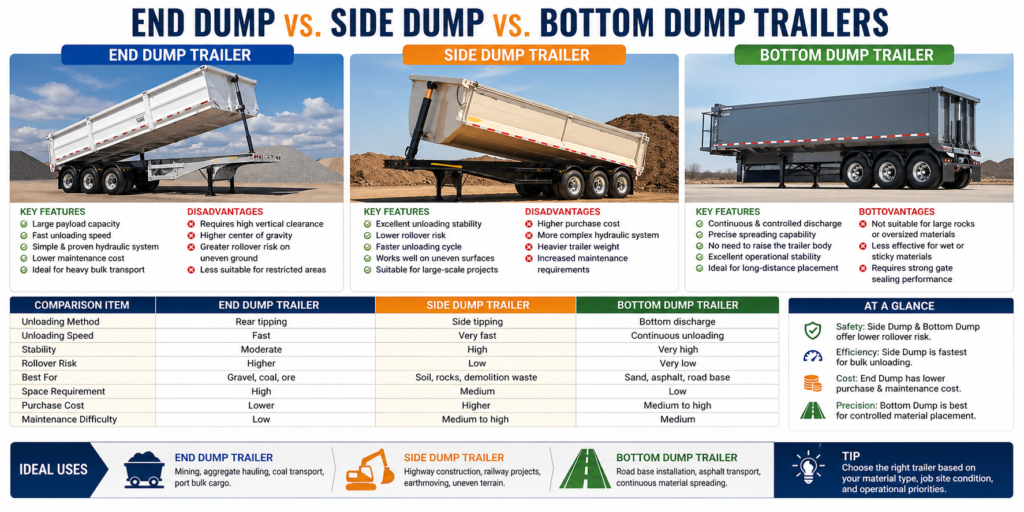
What Is an End Dump Trailer?
An End Dump Trailer is the most traditional and widely used type of dump trailer. It uses a hydraulic lifting system to raise the front of the trailer body, allowing materials to unload from the rear.
This design is commonly used for transporting aggregates, gravel, coal, sand, demolition waste, ore, and agricultural materials. If the cargo is heavy machinery rather than loose material, compare lowbed and flatbed trailers instead.
Key Features of End Dump Trailers
- Large payload capacity
- Fast unloading speed
- Simple and proven hydraulic system
- Lower maintenance costs
- Ideal for heavy bulk material transport
Disadvantages of End Dump Trailers
- Requires high vertical clearance during unloading
- Higher center of gravity when raised
- Greater rollover risk on uneven ground
- Less suitable for restricted unloading areas
For mining operations and high-volume aggregate transport, end dump trailers are often the preferred choice.
What Is a Side Dump Trailer?
A Side Dump Trailer uses hydraulic cylinders to tilt the trailer body sideways, allowing materials to discharge from the side rather than the rear.
This design improves unloading stability and reduces rollover risk, making it highly suitable for large infrastructure projects and challenging terrain.
Key Features of Side Dump Trailers
- Excellent unloading stability
- Lower rollover risk
- Faster unloading cycle
- Works well on uneven surfaces
- Suitable for large-scale earthmoving operations
Disadvantages of Side Dump Trailers
- Higher purchase cost
- More complex hydraulic structure
- Heavier trailer weight
- Increased maintenance requirements
For highway construction, railway projects, and large excavation jobs, side dump trailers often provide better safety and productivity.
What Is a Bottom Dump Trailer?
A Bottom Dump Trailer, also known as a Belly Dump Trailer, unloads material through gates located underneath the trailer body.
Instead of dumping all material at once, it allows continuous and controlled unloading. This makes it highly effective for road building, asphalt work, and base layer spreading.
Key Features of Bottom Dump Trailers
- Continuous and controlled material discharge
- Precise spreading capability
- No need to raise the trailer body
- Excellent operational stability
- Ideal for long-distance road material placement
Disadvantages of Bottom Dump Trailers
- Not suitable for large rocks or oversized materials
- Less effective for wet or sticky materials
- Requires strong gate sealing performance
For contractors focused on paving and road base preparation, bottom dump trailers are often the most efficient option.
End Dump vs Side Dump vs Bottom Dump Trailer: Main Differences
The table below highlights the most important differences between these three trailer types.
| Comparison Item | End Dump Trailer | Side Dump Trailer | Bottom Dump Trailer |
|---|---|---|---|
| Unloading Method | Rear tipping | Side tipping | Bottom discharge |
| Unloading Speed | Fast | Very fast | Continuous unloading |
| Stability | Moderate | High | Very high |
| Rollover Risk | Higher | Low | Very low |
| Best For | Gravel, coal, ore | Soil, rocks, demolition waste | Sand, asphalt, road base |
| Space Requirement | High | Medium | Low |
| Purchase Cost | Lower | Higher | Medium to high |
| Maintenance Difficulty | Low | Medium to high | Medium |
Understanding these differences helps buyers choose the most suitable trailer for their projects.
Which Dump Trailer Is Best for Your Business?
There is no single “best” dump trailer for every business. The right choice depends on your materials, unloading environment, project type, and operational priorities.
Best for High-Volume Bulk Material Hauling
If your main business involves:
- Mining operations
- Coal transportation
- Aggregate hauling
- Port bulk cargo transport
The best option is usually:
End Dump Trailer
Its large payload capacity and fast unloading make it ideal for heavy-duty hauling operations.
Best for Safety and Stability
If your projects include:
- Highway construction
- Railway projects
- Large earthmoving operations
- Rough or uneven terrain
The best option is usually:
Side Dump Trailer
Its stable unloading system makes it a safer choice for demanding construction environments.
Best for Precision Material Spreading
If your work focuses on:
- Road base installation
- Asphalt transport
- Continuous material spreading
- Controlled discharge operations
The best option is usually:
Bottom Dump Trailer
It provides precise unloading control, making it highly efficient for paving and road construction.
Dump Trailer Buying Guide: What to Consider Before Purchasing
Before investing in a dump trailer, buyers should carefully evaluate the following factors.
1. Payload Capacity
Payload requirements vary depending on local road regulations and transportation needs.
Common capacities include:
- 30 Tons
- 40 Tons
- 50 Tons
- 60 Tons
Choosing the correct payload capacity helps improve transport efficiency while ensuring compliance with local regulations.
2. Material Type
The type of material being transported often determines the trailer choice.
For example:
- Large rocks → End Dump Trailer
- Earth and soil → Side Dump Trailer
- Sand and road base → Bottom Dump Trailer
This is often the most important factor in the purchasing decision.
3. Chassis Strength and Structural Quality
Main beam thickness, steel grade, suspension design, and axle brand all affect durability and service life.
Many professional buyers prioritize:
- Q460 high-strength steel
- FUWA axles
- BPW axles
- HYVA hydraulic systems
High-quality components significantly improve long-term performance and reduce maintenance costs.
4. After-Sales Support
Buying a dump trailer is not just about the equipment itself. Reliable after-sales service is equally important.
Key factors include:
- Spare parts availability
- Warranty coverage
- Technical support
- Export experience
- Local service network
For international buyers, strong after-sales support can significantly reduce long-term operating risks.
Frequently Asked Questions (FAQ)
1. Which dump trailer is the safest option?
Side dump trailers and bottom dump trailers are generally considered safer than end dump trailers because they have lower rollover risks during unloading. Side dump trailers are especially suitable for uneven terrain and large construction projects.
2. What is the best dump trailer for mining operations?
End dump trailers are usually the best choice for mining operations because they offer large payload capacity, strong structure, and fast unloading for heavy bulk materials like ore, coal, and gravel.
3. Are bottom dump trailers good for asphalt transportation?
Yes, bottom dump trailers are highly suitable for asphalt transport and road base spreading because they provide continuous and controlled unloading, which improves paving efficiency and precision.
4. Why are side dump trailers more expensive?
Side dump trailers have a more complex hydraulic system, heavier structural design, and higher safety performance. These factors increase both manufacturing costs and purchase prices.
5. What payload capacity should I choose?
The right payload capacity depends on your transportation needs and local road regulations. Common options include 30-ton, 40-ton, 50-ton, and 60-ton dump trailers.
6. Which trailer is best for wet or sticky materials?
End dump trailers are generally better for wet, sticky, or heavy materials because they use gravity-assisted rear unloading. Bottom dump trailers may face discharge problems with sticky materials.
7. How important is the hydraulic system in a dump trailer?
The hydraulic system is one of the most critical components. A reliable hydraulic system improves unloading efficiency, reduces maintenance costs, and increases the service life of the trailer.
8. What should international buyers pay attention to?
International buyers should focus on product quality, export experience, spare parts supply, warranty service, local technical support, and compliance with destination country regulations.
Final Thoughts
When comparing End Dump vs Side Dump vs Bottom Dump Trailers, the goal is not to find the most expensive option or the most popular model—it is to find the trailer that best matches your business needs.
In simple terms:
- Bulk aggregate transport → End Dump Trailer
- High safety and rough terrain → Side Dump Trailer
- Precision spreading and paving → Bottom Dump Trailer
Choosing the right trailer improves efficiency, reduces downtime, and lowers operating costs over the long term.